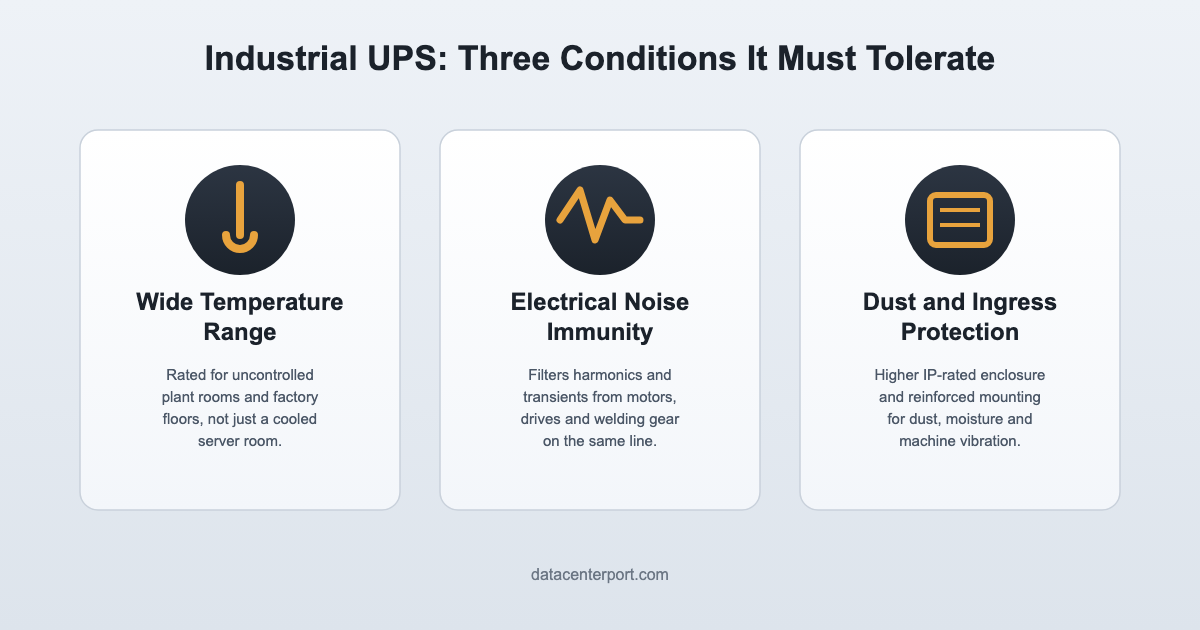
An industrial UPS is a UPS built to run in harsher conditions than a typical data centre: wider temperature range, resistance to dust and vibration, and tolerance for the electrical noise found on factory floors. It protects the same kind of load as a standard UPS, but the enclosure and internal design are hardened for the environment around it.
What makes a UPS “industrial” rather than standard?
A standard data centre UPS is designed for a controlled room: stable temperature, clean power, and no significant vibration. An industrial UPS is built for the opposite conditions. Three design differences separate the two categories.
1. Operating temperature range
Data centre UPS units are typically rated for a narrow band around normal room temperature, because the room itself is cooled to protect the batteries and electronics. Industrial UPS units are rated for a much wider ambient range, since they are often installed in unconditioned factory spaces, plant rooms, or enclosures near production equipment where temperature swings are normal rather than exceptional.
2. Immunity to electrical noise and harmonics
Factory floors run large motors, variable frequency drives, and welding equipment, all of which inject harmonics and voltage transients onto the local power line. An industrial UPS is designed with tighter input filtering and surge protection to keep this noise from reaching the protected load, and to keep its own switching electronics from being disrupted by it. A standard office or data centre UPS assumes a comparatively clean incoming supply and is not tested against the same disturbance profile.
3. Mechanical protection: dust, vibration and ingress
Industrial environments expose equipment to dust, moisture, and mechanical vibration from nearby machinery. Industrial UPS enclosures commonly carry a higher ingress protection (IP) rating and reinforced mounting to survive this, where a data centre UPS enclosure is designed only for a clean, static room and does not need the same sealing or shock resistance.
Where industrial UPS units are actually used
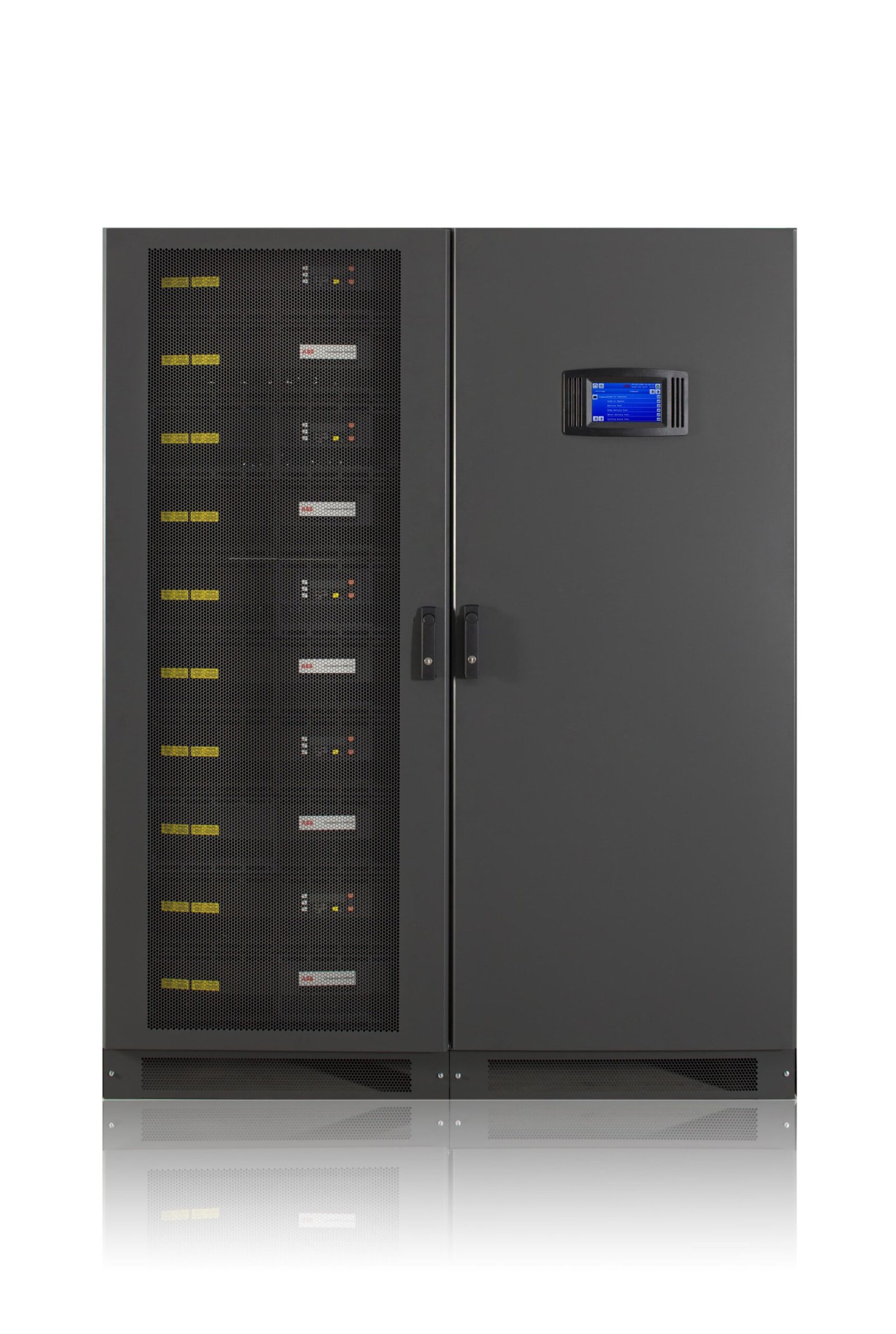
The typical application is protecting a control panel, PLC, SCADA system, or a single critical machine on a production line, rather than an entire server room. A power interruption that would simply restart a server can stop a production line mid-cycle, damage in-process material, or corrupt a control system’s state; the UPS bridges exactly that gap. Industrial UPS units also appear in substations, water treatment plants, and other facilities where the electrical environment is closer to a factory floor than to an office.
Industrial UPS vs data centre UPS: quick comparison
| Factor | Data centre UPS | Industrial UPS |
|---|---|---|
| Operating temperature | Narrow range, controlled room | Wide range, uncontrolled space |
| Input power quality assumed | Relatively clean | Noisy, harmonics and transients expected |
| Enclosure protection | Standard indoor enclosure | Higher IP rating, reinforced mounting |
| Typical load protected | Server racks, network equipment | PLC, control panel, single production machine |
Single-phase and three-phase industrial UPS
Small industrial loads, such as a single control panel or PLC rack, are commonly protected by a compact single-phase UPS sized in the low kVA range. Larger installations, such as an entire production line’s control system or a substation’s auxiliary power, move to three-phase industrial UPS units so the load is balanced across all three phases the same way it would be in a data centre. The environmental hardening described above applies at both scales; what changes with size is the enclosure form factor and whether the unit is rack-mounted, floor-standing, or panel-mounted inside existing switchgear.
Maintenance in a harsher environment
An industrial UPS generally needs more frequent inspection than one sitting in a clean server room, precisely because the conditions it is designed to tolerate still accelerate wear over time. Dust ingress at the enclosure vents, connector corrosion in humid plant rooms, and battery capacity loss from temperature cycling are the three most common failure paths, and all three are checked by routine inspection rather than by the UPS reporting a fault on its own. Facilities that treat an industrial UPS as maintenance-free, the way many data centre teams can with a UPS in a controlled room, are the ones most likely to discover a failed unit only when the power actually goes out.
Sizing considerations that carry over from standard UPS selection
Once the environmental questions are settled, sizing an industrial UPS follows the same logic as sizing any other UPS: add up the real power draw of the protected load, decide how many minutes of runtime the process actually needs to shut down safely or ride through a short outage, and leave headroom for future additions to the panel. The environmental hardening changes the enclosure and input design, not the basic capacity math.
Battery technology in industrial settings
Battery choice matters more in industrial deployments than in a climate-controlled server room, because ambient temperature directly affects battery life: lead-acid battery life drops sharply outside its designed temperature band, which is exactly the condition an industrial UPS is likely to face. This is one of the reasons lithium-ion battery packs, which tolerate a wider temperature range with less degradation, are increasingly specified for industrial UPS installations rather than for cost reasons alone.
Choosing between a standard and an industrial UPS
The deciding question is not the load itself but the room it sits in. A server rack or network cabinet in a conditioned room is well served by a standard UPS. A control panel, PLC, or single machine on an uncontrolled factory floor, in a plant room with temperature swings, or near equipment that generates electrical noise needs the wider tolerances an industrial UPS is built for. Specifying a standard UPS in that second environment does not fail immediately, but it shortens battery and electronics life and raises the odds of a nuisance trip exactly when the protected process cannot afford one.
Where industrial UPS selection overlaps with standard UPS ranges
Not every industrial-grade requirement needs a purpose-built industrial product line. Some three-phase UPS families are offered in ratings that cover both a controlled data centre installation and a plant-room installation, with the environmental hardening added as an option on the same base platform rather than as a separate product. When evaluating suppliers, it is worth asking specifically whether the enclosure, temperature rating, and input filtering have been tested for the target environment, rather than assuming a UPS rated for a given kW figure will behave the same way in a server room and on a factory floor.
For the data centre and server room side of the same decision, see what a UPS is and how it protects a load and the full UPS product range. Three-phase families such as Galaxy VS, with its modular power blocks, and the price-led Easy UPS 3S/3M/3L range cover the smaller kW bands typically specified for panel and plant-room protection.
Need a quote on this?
Send the load, the capacity and the delivery country. A priced quote comes back within 48 hours.
Request a Quote