An uninterruptible power supply, or UPS, is a device that keeps connected equipment powered when the mains supply fails or drifts outside tolerance, using energy stored in batteries. In a data centre it does two jobs at once: it bridges the seconds before a generator takes over, and while the mains is present it conditions the supply so that sags, surges and frequency drift never reach the equipment.
What a UPS is actually for
It is tempting to describe a UPS as a big battery. That is the least interesting thing about it. A mains supply that never fails completely can still be unusable: voltage that dips when a large motor starts, spikes when it stops, and frequency that wanders on a generator. Equipment tolerates a surprising amount of this until it suddenly does not, and the failure appears as a corrupted database or a dead power supply rather than as an obvious power event.
A UPS sits between that supply and the load and guarantees what the load sees. The battery covers the outage case. The electronics cover everything else, and in most installations the electronics do far more work than the battery ever will.
The three topologies
Almost every UPS on the market is one of three designs, and the difference between them is where the load gets its power from under normal conditions.
Offline, also called standby. The load runs directly from the mains. When the mains fails, a switch transfers to an inverter fed by the battery. The transfer takes a few milliseconds. It is the cheapest design and it is appropriate for a desktop computer, not for a rack.
Line-interactive. The same idea plus automatic voltage regulation, so moderate sags and swells are corrected without touching the battery. This extends battery life considerably in areas with poor supply quality. There is still a transfer when the mains fails.
Online, also called double conversion. Incoming AC is converted to DC and back to AC continuously, so the load is always fed from the inverter and never directly from the mains. Because the output is regenerated rather than filtered, there is no transfer time at all, and voltage and frequency are held steady regardless of what the input does. This is the type specified for anything in a data centre.
Comparing the three
| Property | Offline | Line-interactive | Online |
|---|---|---|---|
| Transfer time on mains failure | A few milliseconds | A few milliseconds | None |
| Voltage regulation without battery | No | Yes, within a range | Yes, always |
| Output frequency held steady | No | No | Yes |
| Typical capacity range | Under 1.5 kVA | Up to about 5 kVA | 1 kVA upward, no practical ceiling |
| Suitable for a rack | No | Edge cases only | Yes |
kVA and kW are not the same number
UPS capacity is quoted in both kVA (apparent power) and kW (real power). The ratio between them is the power factor. Older units were often rated at 0.8, meaning a 100 kVA UPS delivered 80 kW. Current designs are typically unity, so 100 kVA is 100 kW.
This matters because modern server power supplies also run close to unity power factor. If you size against the kVA figure of a 0.8-rated unit, you will be roughly twenty per cent short in the only unit that counts. Size against kW. It is the figure the load actually consumes.
Formats: rack, tower and floor-standing
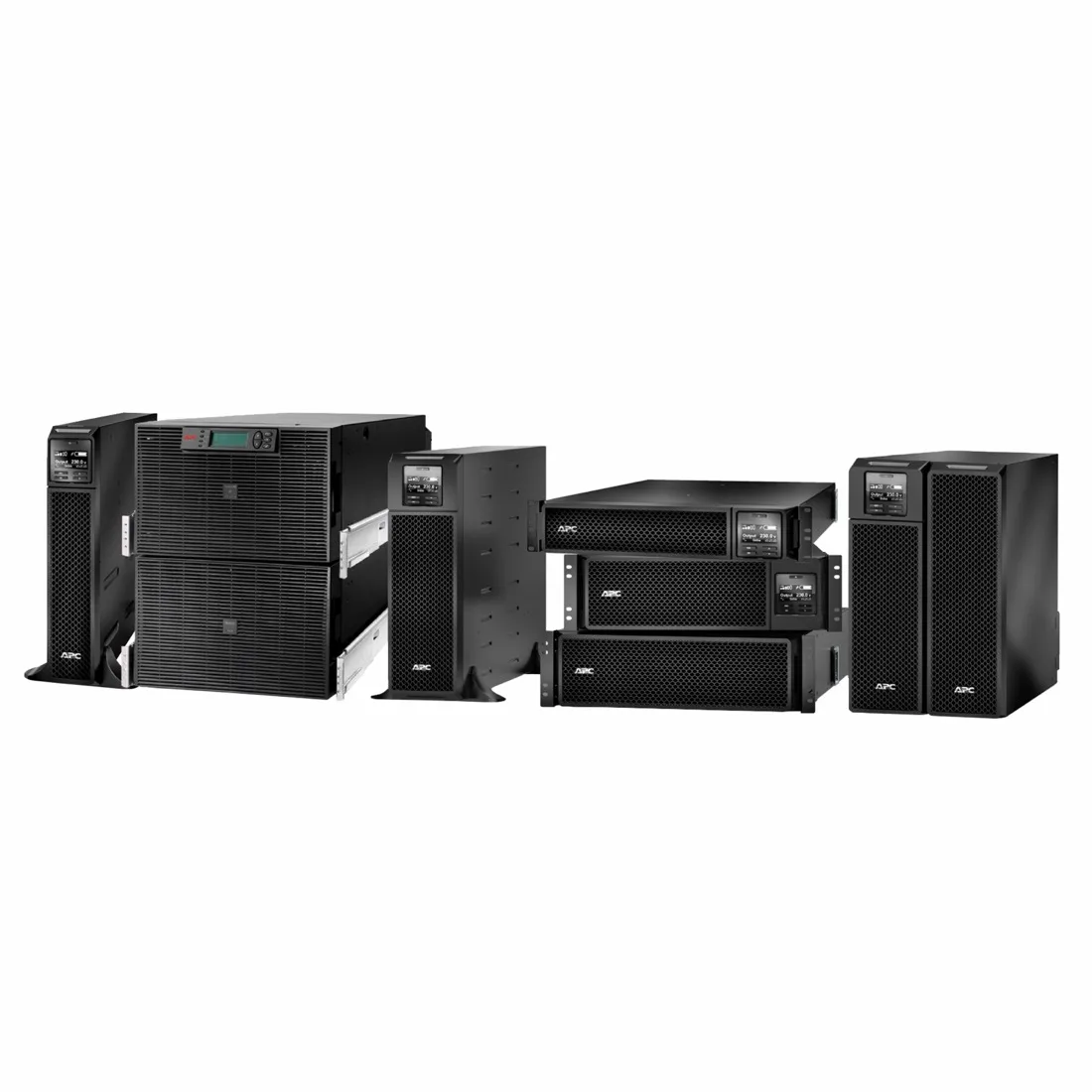
Below roughly 20 kVA a UPS is normally a rack unit of 1U to 4U, single-phase, fed from an ordinary socket circuit and installed in the cabinet it protects. Some models convert between rack and tower orientation for rooms without a cabinet.
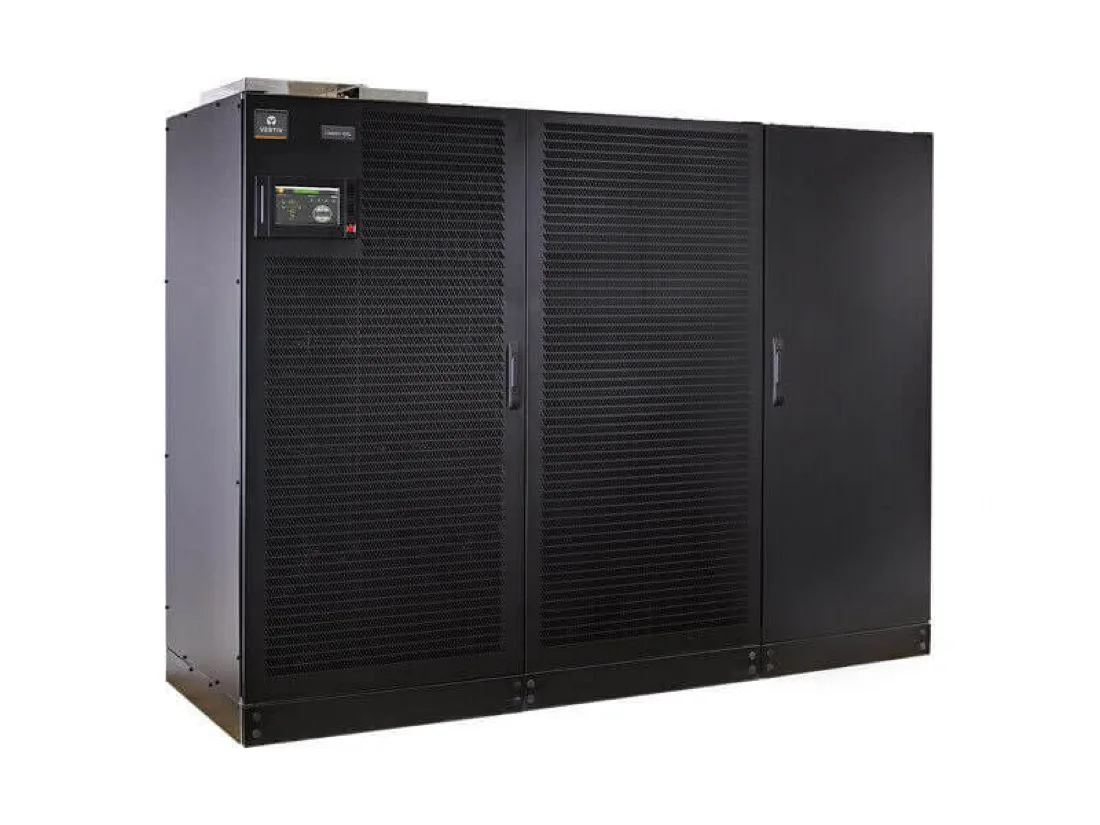
Above that threshold you move to three-phase floor-standing frames. These need their own switchgear, a battery cabinet beside them, floor loading that supports the weight and a maintenance bypass so the unit can be taken out of circuit without dropping the load. Our UPS systems page lists the families we supply from 1 kVA up to 1200 kVA, and up to 3.4 MW in multi-module configurations.
Modular or monolithic
A modular UPS is built from identical hot-swappable power modules in a common frame. Capacity is added by inserting modules rather than by replacing the unit, and N+1 redundancy costs one extra module instead of a second complete system. It costs more per kW at the start and repays that only if the load genuinely grows.
A monolithic unit is cheaper and simpler when the final load is already known, which is often the case in a fixed telecom room or a single-purpose installation.
Batteries decide the runtime, not the UPS
Runtime depends on how much of the UPS capacity you actually draw. A unit loaded to half its rating runs considerably more than twice as long as one at full load, because battery discharge is not linear. Typical rack installations are specified for five to fifteen minutes at full load, which is enough to bridge to a generator or to shut systems down cleanly.
If you need an hour, you are buying a battery cabinet, and the floor loading and room ventilation become part of the specification rather than an afterthought. Lithium-ion occupies roughly half the footprint of an equivalent lead-acid string and lasts substantially longer, at a higher purchase price.
Where the UPS sits in the chain
A UPS is one stage of a power path, not the whole of it. Upstream, an automatic transfer switch moves the building between mains and generator. Downstream, a rack PDU distributes the conditioned output to individual outlets inside the cabinet. Sizing any one of the three without the other two is how installations end up with a UPS that cannot be fed and a PDU that cannot be filled.
What to have ready before asking for a quote
- The load in kW, measured if possible rather than added from nameplates
- The runtime you need, and whether a generator exists and how fast it starts
- Single-phase or three-phase incoming supply, and the circuit rating available
- Whether you need redundancy now or expect to add it later
- Where the unit will physically stand, and whether a battery cabinet fits beside it
Those five answers are usually enough to produce a priced configuration without a second round of questions.
Need a quote on this?
Send the load, the capacity and the delivery country. A priced quote comes back within 48 hours.
Request a Quote