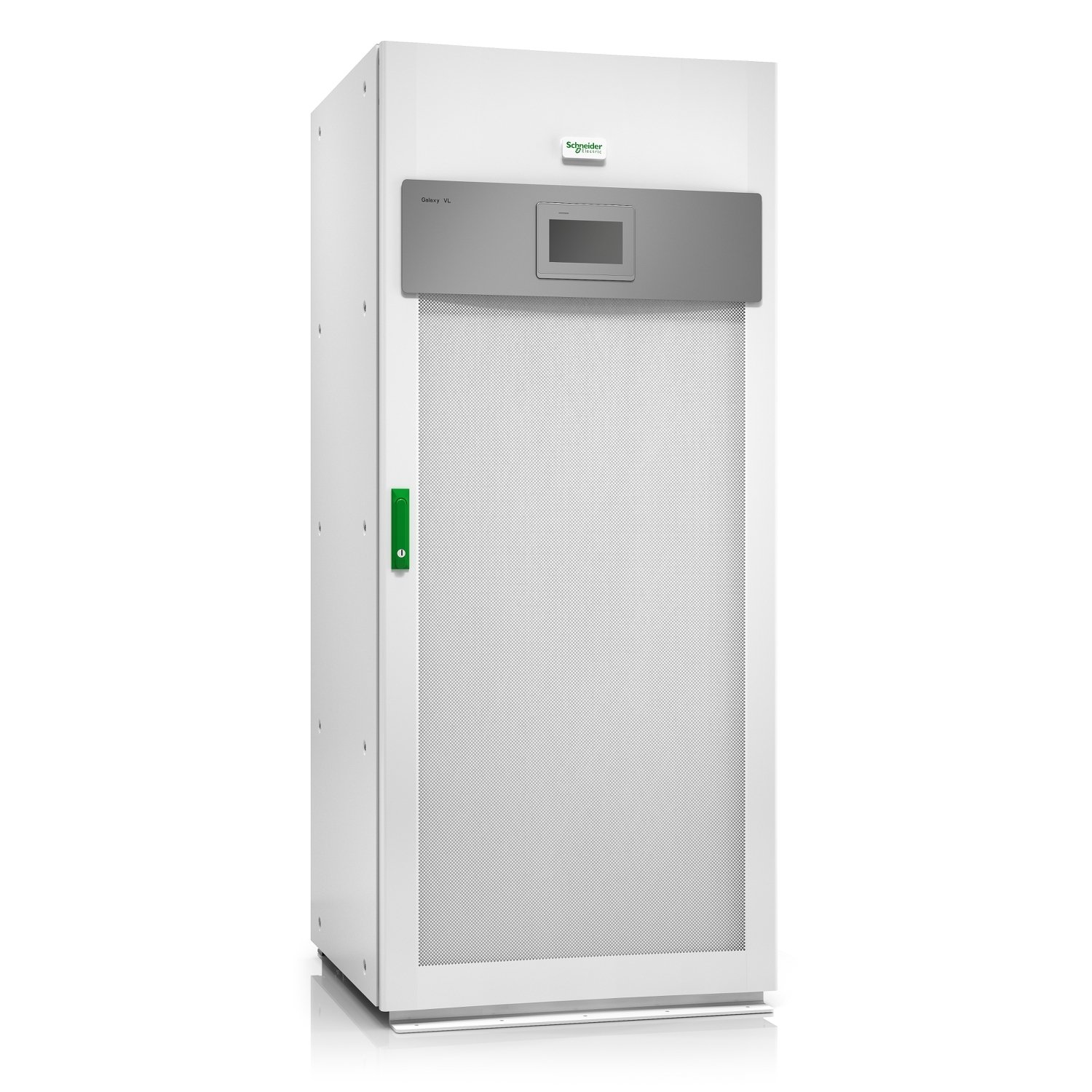
The Schneider Electric Galaxy series is a single three-phase UPS family that spans 10 kW to 1500 kW. It has four models: Galaxy VS for entry and mid-scale loads, Galaxy VL for compact mid-to-large scale, Galaxy VX for large data centres, and Galaxy VXL, the newest generation built for the highest power density.
Galaxy VS: 10-150 kW, modular power blocks
Galaxy VS scales from 10 kW to 150 kW through modular power blocks (model codes GVSUPS10K/20K/30K/40K/50K/60K/80K/100K/120K/150K HS). Instead of installing the full target capacity on day one, the modular design lets capacity be added block by block as load grows, which lowers the initial investment. It is a common choice for edge sites and mid-scale data centres.
Galaxy VL: 200-500 kW, compact and scalable
Galaxy VL covers 200-500 kW (model codes GVL200 through GVL500 K500HS) and runs on 400/480 V. It sits between Galaxy VS and Galaxy VX, and is chosen for projects that need high power density in a single unit without the larger footprint of the VX line.
Galaxy VX: 500-1500 kW, large data centre scale
Galaxy VX covers 500-1500 kW in a single scalable unit (model codes GVX500 through GVX1500 K1500). It is built for large data centres and colocation facilities that would otherwise need many smaller UPS units; capacity and redundancy can both be increased by running units in parallel.
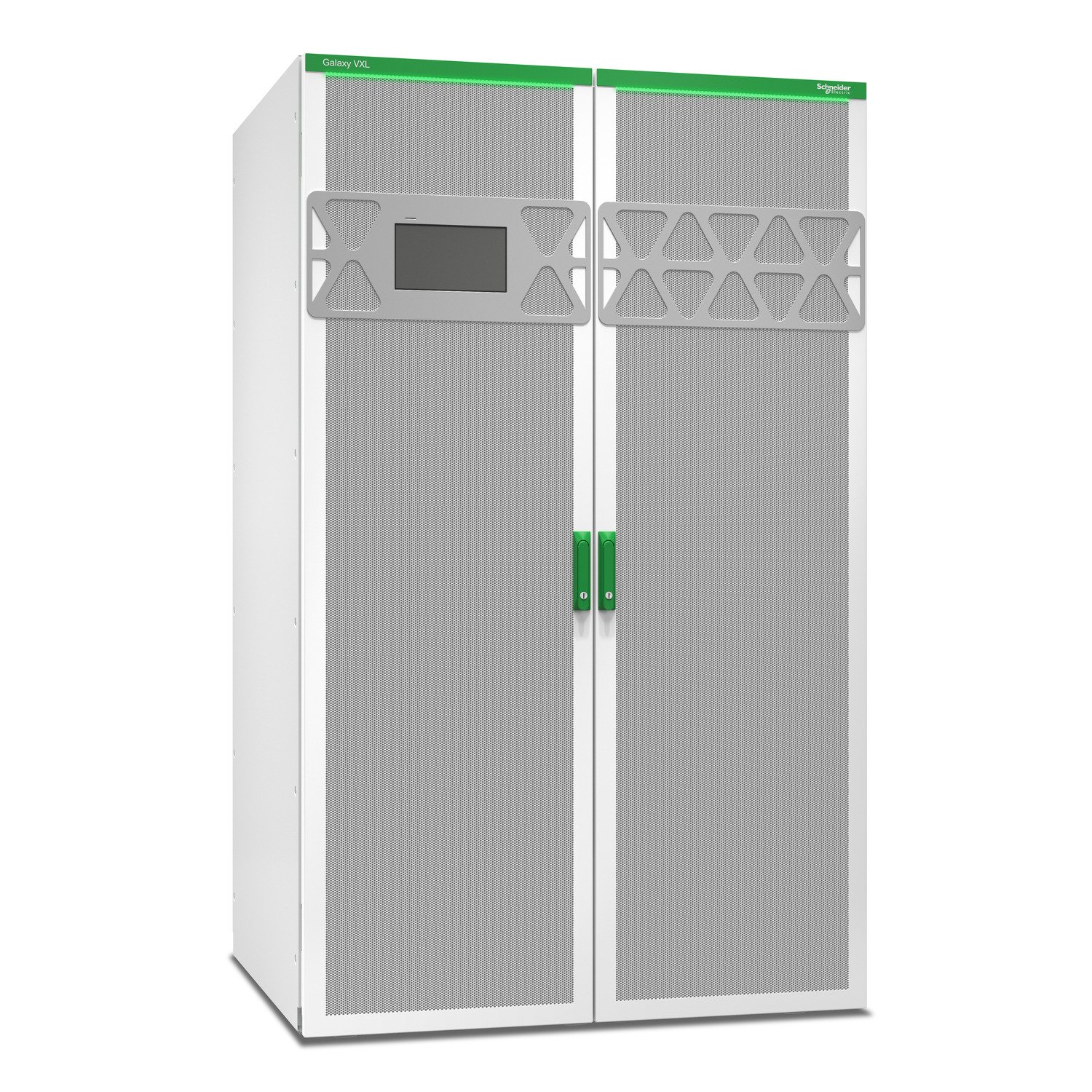
Galaxy VXL: the newest generation, highest power density
Galaxy VXL (model codes GVXL500K1250HS through GVXL1250KHS) covers 500-1250 kW at 400 V and is the family’s newest member, introduced from 2024 onward. It targets a smaller footprint than earlier models at a comparable power rating, and has started replacing Galaxy VX in newly commissioned projects.
Choosing between overlapping power ranges
Galaxy VX and Galaxy VXL both cover part of the 500-1250 kW band, so a load in that range does not automatically point to one model. The deciding factors are usually footprint and generation: VXL packs a comparable rating into a smaller physical space and is the newer platform, while VX has a longer field track record at the same scale. A project with tight floor space or a preference for the latest generation leans toward VXL; a project that values a longer-proven platform at the same power level may still choose VX. Below that overlap, the choice is more direct: a fixed 200-500 kW requirement fits Galaxy VL without the added complexity of a parallel VS system, while a load under 150 kW that is still expected to grow is better served by Galaxy VS, precisely because its modular blocks let capacity increase without replacing the installed unit.
Galaxy series comparison table
| Model | Power range | Model codes | Defining feature |
|---|---|---|---|
| Galaxy VS | 10-150 kW | GVSUPS10K…150K HS | Modular power blocks |
| Galaxy VL | 200-500 kW | GVL200…500 K500HS | Compact, 400/480 V |
| Galaxy VX | 500-1500 kW | GVX500…1500 K1500 | Large scale in a single unit |
| Galaxy VXL | 500-1250 kW (400 V) | GVXL500K1250HS…GVXL1250KHS | Newest generation, highest density |
What modular design actually delivers
The modular architecture behind Galaxy VS separates capacity from redundancy. Rather than sizing and buying for the full eventual load, a site installs only the power blocks it needs today and adds more as demand grows, without re-engineering the installation. The same architecture supports redundancy: in an N+1 configuration, one power module can fail while the remaining modules continue carrying the load, and that module can be serviced without shutting the system down. Galaxy VL, VX and VXL scale a different way, through parallel units rather than smaller internal blocks, but the underlying redundancy logic is the same.
Battery options
Every model in the Galaxy series is designed to work with either conventional VRLA (lead-acid) batteries or lithium-ion battery cabinets. Lithium-ion delivers the same backup time in a smaller, lighter cabinet and lasts longer in service than VRLA, at a higher upfront cost. Which battery technology fits a given project depends on the runtime target and how much floor space the battery room can spare.
Parallel operation and redundancy level
Galaxy VL, VX and VXL support connecting multiple units in parallel once a single unit’s capacity is not enough. Two redundancy approaches follow from this: N+1 adds one extra unit beyond what the load requires, so a single unit failure does not reduce available capacity; 2N splits the full load across two completely independent UPS paths for the highest level of continuity, the approach typically chosen for colocation and enterprise data centre projects. The redundancy level is a separate decision from raw power requirement, driven by how much downtime the project can tolerate.
Where the Galaxy series is used beyond large data centres
The series is not limited to large facilities. The lower end of Galaxy VS, in the 10-40 kW range, protects critical distribution panels in hospitals, manufacturing plants, and telecom exchanges, where the priority is the flexible maintenance window the modular design provides rather than raw power. Galaxy VL and above become the relevant choice as scale grows toward colocation, cloud, and enterprise data centre projects.
Field installation considerations
Planning an installation means accounting for three site constraints beyond the power rating itself: the unit’s weight against the floor’s load rating, the additional floor space the battery cabinet needs, and cable entry and exit space in the electrical room. This matters most for the higher-capacity Galaxy VX and VXL models, where the battery group can take up as much planning attention as the UPS itself; choosing lithium-ion batteries reduces that footprint, which is one reason it gets specified on space-constrained sites.
Why one series instead of a brand comparison
This article deliberately compares Galaxy’s four models against each other rather than against competing brands. A buyer with a load anywhere between 10 kW and 1500 kW is more likely asking which Galaxy model fits that load than asking which brand to choose. Comparing within one family, by power range, footprint, and generation, leads to a more concrete purchasing decision than a general brand-versus-brand comparison would.
Full specifications, dimensions, and weight for each model are on its own product page: Galaxy VS, Galaxy VL, Galaxy VX and Galaxy VXL.
Need a quote on this?
Send the load, the capacity and the delivery country. A priced quote comes back within 48 hours.
Request a Quote