Galaxy VS: 10 to 150 kW modular three-phase UPS
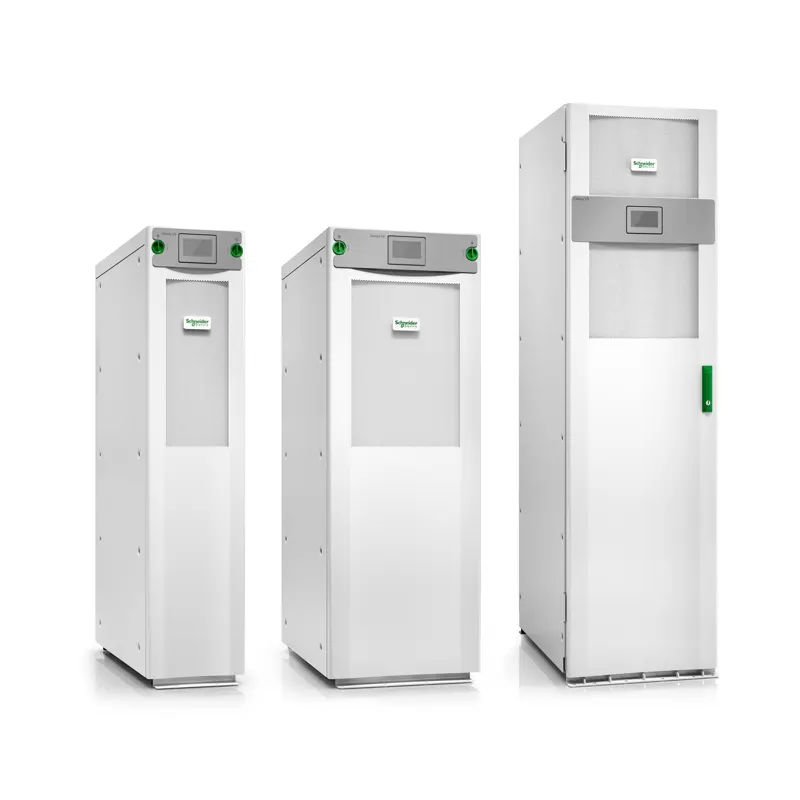
Galaxy VS is Schneider Electric’s modular three-phase UPS for the 10 to 150 kW band, which is where most edge sites and mid-size data centre rooms land. It is built from power modules in a single frame, so a room can start at part load and grow without a second installation. This is the family we quote most often when the load is real but the room is not a hyperscale hall.
Technical specification
| Model code | Power | Input / output voltage | Phases | Topology | Efficiency | Dimensions W×D×H (mm) | Weight | Parallel / redundancy | Battery type |
|---|---|---|---|---|---|---|---|---|---|
| GVSUPS10KHS | 10 kW | 400 V AC | Three-phase | On-line double conversion; eConversion; modular with Live Swap | Up to 99% in eConversion mode | 521 × 847 × 1485 | – | Up to 4 UPSs in parallel for capacity or redundancy; internal N+1 power module | VRLA, modular battery, lithium-ion |
| GVSUPS20KHS | 20 kW | 400 V AC | Three-phase | On-line double conversion; eConversion; modular with Live Swap | Up to 99% in eConversion mode | 521 × 847 × 1485 | 206 kg | Up to 4 UPSs in parallel for capacity or redundancy; internal N+1 power module | VRLA, modular battery, lithium-ion |
| GVSUPS30KHS | 30 kW | 400 V AC | Three-phase | On-line double conversion; eConversion; modular with Live Swap | Up to 99% in eConversion mode | 521 × 847 × 1485 | 206 kg | Up to 4 UPSs in parallel for capacity or redundancy; internal N+1 power module | VRLA, modular battery, lithium-ion |
| GVSUPS40KHS | 40 kW | 400 V AC | Three-phase | On-line double conversion; eConversion; modular with Live Swap | Up to 99% in eConversion mode | 521 × 847 × 1485 | 206 kg | Up to 4 UPSs in parallel for capacity or redundancy; internal N+1 power module | VRLA, modular battery, lithium-ion |
| GVSUPS50KHS | 50 kW | 400 V AC | Three-phase | On-line double conversion; eConversion; modular with Live Swap | Up to 99% in eConversion mode | 521 × 847 × 1485 | 206 kg | Up to 4 UPSs in parallel for capacity or redundancy; internal N+1 power module | VRLA, modular battery, lithium-ion |
| GVSUPS60KHS | 60 kW | 400 V AC | Three-phase | On-line double conversion; eConversion; modular with Live Swap | Up to 99% in eConversion mode | 521 × 847 × 1485 | 238 kg | Up to 4 UPSs in parallel for capacity or redundancy; internal N+1 power module | VRLA, modular battery, lithium-ion |
| GVSUPS80KHS | 80 kW | 400 V AC | Three-phase | On-line double conversion; eConversion; modular with Live Swap | Up to 99% in eConversion mode | 521 × 847 × 1485 | 250 kg | Up to 4 UPSs in parallel for capacity or redundancy; internal N+1 power module | VRLA, modular battery, lithium-ion |
| GVSUPS100KHS | 100 kW | 400 V AC | Three-phase | On-line double conversion; eConversion; modular with Live Swap | Up to 99% in eConversion mode | 521 × 847 × 1485 | 250 kg | Up to 4 UPSs in parallel for capacity or redundancy; internal N+1 power module | VRLA, modular battery, lithium-ion |
| GVSUPS120KHS | 120 kW | 400 V AC | Three-phase | On-line double conversion; eConversion; modular with Live Swap | Up to 99% in eConversion mode | 521 × 847 × 1485 | 278 kg | Up to 4 UPSs in parallel for capacity or redundancy; internal N+1 power module | VRLA, modular battery, lithium-ion |
| GVSUPS150KHS | 150 kW | 400 V AC | Three-phase | On-line double conversion; eConversion; modular with Live Swap | Up to 99% in eConversion mode | 521 × 847 × 1485 | 290 kg | Up to 4 UPSs in parallel for capacity or redundancy; internal N+1 power module | VRLA, modular battery, lithium-ion |
Reading the model code
The Galaxy VS references in the table above end in HS, which is the 400 V variant. Schneider Electric also builds this family at 208 V and at 480 V, and the reference is the only thing that separates them. The frame looks identical in a photograph, but the voltage is fixed at the factory and is not a field change. The number in the middle of the reference is the kW rating, so GVSUPS100KHS is a 100 kW unit at 400 V. Two consequences follow for a buyer. First, confirm the site voltage before you compare offers, because a price quoted against the wrong reference is not a price you can use. Second, when you read a datasheet you found online, check which voltage variant it covers. The dimensions and weights published for this family come from the 480 V technical specification, and that document names the variant on every table. Send us the incoming supply voltage and the load in kW, and we will name the exact reference rather than the family.
Source of the values: Schneider Electric, Galaxy VS teknik sartname 990-91140G-001 (480 V) + 3 fazli UPS portfoy katalogu. Dimensions and weights are the values published in the Galaxy VS 480 V technical specification; the document lists the same frame for every variant. An en dash means the manufacturer does not publish that value; we do not fill it in with an estimate. Confirm every figure against the current manufacturer document before it is written into a contract.
The references we quote in this family are GVSUPS10KHS, GVSUPS20KHS, GVSUPS30KHS, GVSUPS40KHS, GVSUPS50KHS, GVSUPS60KHS, GVSUPS80KHS, GVSUPS100KHS, GVSUPS120KHS and GVSUPS150KHS. Send us the reference if you already have one, or the load in kW and the runtime if you do not, and we will confirm availability and lead time.
Which one should you choose?
Why the modular frame matters here
Between 10 and 150 kW the final load is rarely known on day one. A modular frame lets you buy the capacity the room needs now and add modules as racks fill, rather than oversizing on day one and running the unit at a low load factor for three years. The trade-off is a higher cost per kW at the start, which pays back only if the growth is genuine.
Where it fits and where it does not
Galaxy VS covers edge rooms, branch data centres, hospital and industrial IT rooms and the mid-size colocation suite. Below roughly 20 kW a single-phase rack unit is cheaper and simpler to install. Above 150 kW the family runs out and the conversation moves to Galaxy VL or VX, or to a competing modular frame in the same class.
What we need from you to quote it
The load in kW rather than kVA, the runtime target, whether a generator is present and how fast it starts, and the incoming supply arrangement. Model codes in this family run from GVSUPS10K to GVSUPS150K HS and the difference between them is capacity and battery arrangement, not feature set, so the sizing decides the code.
Battery arrangement is a separate decision
The UPS frame and the battery are quoted as two lines, and they behave differently. The frame is fixed by the load; the battery is fixed by how long you need to survive without mains. Internal batteries suit short autonomy; anything beyond a few minutes at the top of this range means an external cabinet, and the cabinet needs floor space and ventilation you have to find before the order.
Service access and clearances
A modular frame is only serviceable if the room lets you reach it. Front access is the norm for module replacement, but check the clearance in front of the unit against the door swing and the aisle width before the layout is fixed. A UPS you cannot open in place becomes a UPS you have to shut down to service.
Request a Quote
Tell us the load in kW, the runtime you want and the delivery country. A priced quote comes back within 48 hours, usually with a second option so the trade-off is visible.