UPS battery backup is the stored energy that carries the load when the mains fails. How long it lasts depends on how much of the UPS capacity you actually draw, what battery technology is installed and how old the batteries are. It is quoted in minutes at a stated load, and it is the single largest cost driver in most UPS installations after the unit itself.
Runtime is not linear
A UPS loaded to half its rating runs considerably more than twice as long as one at full load. Battery discharge is non-linear, and the effect is large enough that it changes purchasing decisions: buying a slightly larger UPS can be cheaper than buying more batteries for a smaller one.
It also means that a runtime figure quoted without a load figure is meaningless. Ten minutes at what load is the only useful question.
How much runtime do you actually need
The answer follows from what happens next, not from a comfort level.
| Situation | Typical target | What the battery is covering |
|---|---|---|
| Generator on site, starts in seconds | 5 to 10 minutes | The start sequence, plus a failed first attempt |
| No generator, staff on site | 10 to 15 minutes | A controlled shutdown of everything |
| No generator, unattended site | 15 to 30 minutes | Automated shutdown plus a margin for scripts |
| Process that cannot be interrupted | Assessed case by case | Whatever the process takes to reach a safe state |
Beyond roughly fifteen minutes you are buying a battery cabinet rather than internal batteries, and floor loading, ventilation and room space become part of the specification rather than an afterthought.
VRLA and lithium-ion
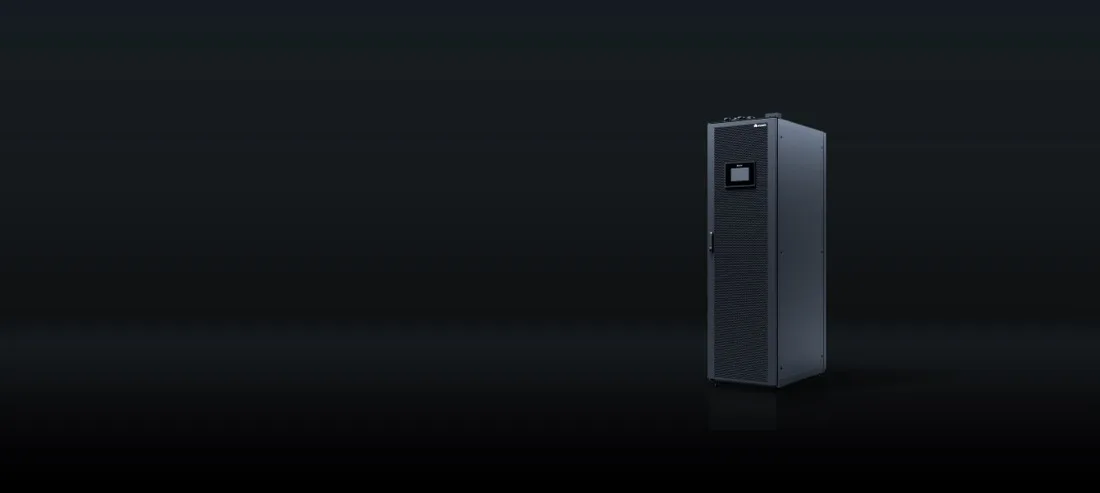
Valve-regulated lead-acid, VRLA, is the traditional choice. It is cheap to buy, widely available and well understood. It is heavy, it is sensitive to temperature and its usable life in a real installation is often shorter than the datasheet suggests.
Lithium-ion costs more up front and changes several things at once: roughly half the footprint for the same energy, two to three times the service life, higher tolerance of warm rooms, faster recharge and a battery management system that reports state of health instead of leaving you to guess.
The comparison that decides it is not price per kWh but total cost across the life of the installation, including the replacement cycles you avoid and the floor space you do not have to find.
What actually kills a battery
Three things, and all three are properties of the installation rather than the product.
Temperature. VRLA cells are designed for 20 to 25 degrees C, and life roughly halves for every 8 to 10 degrees above that range. The reason a UPS room is cooled is usually the batteries, not the electronics.
Cycles. Every discharge takes something from the capacity. On a site with frequent mains interruptions, a battery reaches end of life far sooner than the same product on a stable supply.
Imbalance. In a series string, one weak cell limits the whole string. This is why replacing a single cell is usually not the answer and the string is renewed together.
Replace on measurement, not on the calendar
A battery that has never been tested under load is an assumption, not a protection. Two measurements tell you where you actually stand.
- Internal resistance, measured annually per block. Rising resistance is the earliest reliable warning.
- A discharge test under real load, periodically. This is the only measurement that answers the question you care about.
Monitoring systems that trend both over time turn battery replacement from a budget surprise into a planned item. Lithium installations give you much of this from the battery management system without additional instrumentation.
Charging and recharge time
After a discharge, the battery has to be recharged before it can cover the next event. Recharge time is a specification that rarely gets asked about and occasionally matters a great deal: a site with repeated short outages can find its battery never returns to full charge between them.
Lithium recharges substantially faster than VRLA, which is one of the less-discussed reasons it suits sites with unstable supply.
Sizing the battery and the UPS together
The frame and the battery are two lines in a quote and they behave differently. The frame is fixed by the load in kW. The battery is fixed by how long you need to survive without mains. Deciding the second after the electrical design is finished is how installations discover on installation day that there is no room beside the cabinet.
Decide both at the same time, and check the third number too: the input circuit. A UPS recharging a large battery draws more than its steady-state load, and the supply has to carry that.
Safety and disposal
Batteries at this scale are a regulated waste stream, and lead-acid and lithium have different requirements. Factor in removal and disposal when you compare replacement costs, and confirm who is responsible for it in the supply agreement rather than after the pallet arrives.
Where the batteries physically go
Internal batteries suit short autonomy on small units. Beyond that the batteries live in a cabinet beside the UPS, and that cabinet has three requirements people discover late: floor loading, because a battery cabinet is dense; ventilation, because lead-acid cells vent hydrogen under charge; and access, because the string has to be replaceable without dismantling the room.
Measure the space before the order, not after. A battery cabinet that will not fit through the door is a common and entirely avoidable problem.
What to send with an enquiry
- The load in kW and the runtime you want at that load
- Whether a generator exists and how quickly it accepts load
- Existing UPS model if the battery is a replacement
- Room temperature range and available floor area beside the unit
- Whether lithium is in scope or lead-acid is required
Our UPS systems page lists the families we supply. If you are still choosing the unit itself, the transfer switch upstream and the rack PDU downstream are the two decisions that travel with it.
Need a quote on this?
Send the load, the capacity and the delivery country. A priced quote comes back within 48 hours.
Request a Quote