ABB MegaFlex DPA: 250 to 1500 kW at 97.4% efficiency
MegaFlex DPA is ABB’s large modular UPS, rated 250 to 1500 kW with a stated efficiency of 97.4% in double conversion. DPA stands for decentralised parallel architecture: each module carries its own control and its own critical components, so no single shared element can take the system down. At this scale the efficiency figure is not a marketing line, it is an operating cost.
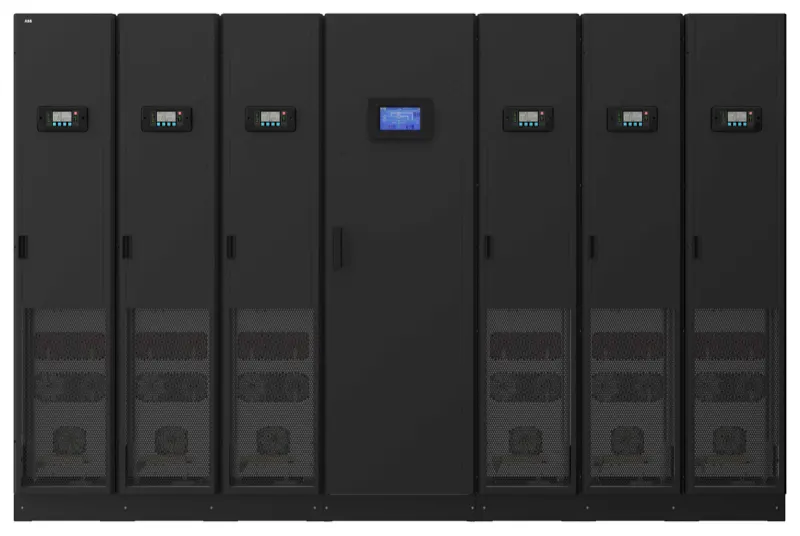
Technical specification
| Model code | Power | Input / output voltage | Phases | Topology | Efficiency | Dimensions W×D×H (mm) | Weight | Parallel / redundancy | Battery type |
|---|---|---|---|---|---|---|---|---|---|
| MegaFlex DPA 250 kW | 250 kW | – | Three-phase | Modular decentralized parallel architecture (DPA), 250 kW power modules; distributed or centralized static bypass | Up to 97.4% system (VFI); up to 99% ECO; 97.6% module | – | – | Can be paralleled with additional systems, modular up to 6000 kW | – |
| MegaFlex DPA 500 kW | 500 kW | – | Three-phase | Modular decentralized parallel architecture (DPA), 250 kW power modules; distributed or centralized static bypass | Up to 97.4% system (VFI); up to 99% ECO; 97.6% module | – | – | Can be paralleled with additional systems, modular up to 6000 kW | – |
| MegaFlex DPA 750 kW | 750 kW (N+1) | – | Three-phase | Modular decentralized parallel architecture (DPA), 250 kW power modules; distributed or centralized static bypass | Up to 97.4% system (VFI); up to 99% ECO; 97.6% module | 2235 × 1000 × 2000 | 1940 kg (with power modules) | Can be paralleled with additional systems, modular up to 6000 kW | – |
| MegaFlex DPA 1000 kW | 1000 kW | – | Three-phase | Modular decentralized parallel architecture (DPA), 250 kW power modules; distributed or centralized static bypass | Up to 97.4% system (VFI); up to 99% ECO; 97.6% module | 2235 × 1000 × 2000 | 1940 kg (with power modules) | Can be paralleled with additional systems, modular up to 6000 kW | – |
| MegaFlex DPA 1250 kW | 1250 kW | – | Three-phase | Modular decentralized parallel architecture (DPA), 250 kW power modules; distributed or centralized static bypass | Up to 97.4% system (VFI); up to 99% ECO; 97.6% module | – | – | Can be paralleled with additional systems, modular up to 6000 kW | – |
| MegaFlex DPA 1500 kW | 1500 kW | – | Three-phase | Modular decentralized parallel architecture (DPA), 250 kW power modules; distributed or centralized static bypass | Up to 97.4% system (VFI); up to 99% ECO; 97.6% module | 3045 × 1000 × 2000 | 3250 kg (with power modules) | Can be paralleled with additional systems, modular up to 6000 kW | – |
Source of the values: ABB MegaFlex DPA brosur. Figures are for the MegaFlex DPA variant with distributed static bypass; the CSB variant with centralized static bypass has different dimensions. An en dash means the manufacturer does not publish that value; we do not fill it in with an estimate. Confirm every figure against the current manufacturer document before it is written into a contract.
The references we quote in this family are MegaFlex DPA 250 kW, MegaFlex DPA 500 kW, MegaFlex DPA 750 kW, MegaFlex DPA 1000 kW, MegaFlex DPA 1250 kW and MegaFlex DPA 1500 kW. Send us the reference if you already have one, or the load in kW and the runtime if you do not, and we will confirm availability and lead time.
Which one should you choose?
What one efficiency point costs at this scale
At 1000 kW, one percentage point of efficiency is roughly 10 kW of continuous heat. You pay for it twice: once to generate it and once to remove it with cooling. Over a decade that arithmetic dominates the purchase price difference between competing units, which is why the figure is quoted so prominently in this class.
Decentralised architecture, in plain terms
Each module in a DPA frame has its own rectifier, inverter, control logic and static bypass. There is no shared controller whose failure stops everything. Practically, that means a module fault is a module fault rather than a system event, and modules can be serviced independently.
Ask for efficiency at your load factor
A headline efficiency figure is measured at a specific load point. A unit running at 35% load behaves differently from the same unit at 80%. Ask for the curve at the load factor you will actually operate, because that is the number that turns into your electricity bill.
Commissioning and load-bank testing
A unit of this rating is not energised the day it arrives. Site acceptance, battery forming and load-bank testing all take time and all need the room and the generator ready. Put them into the project programme at quotation stage, because that is where large-power projects usually lose weeks.
Where it fits, and where it does not
Fits a large data hall or industrial installation between 250 and 1500 kW where running cost over a decade is part of the evaluation, not just purchase price. Does not fit a room under 250 kW, and does not fit a project where only the initial price is scored.
What we need in order to quote it
- Load in kW and the load factor you expect to run at
- Redundancy level and whether N+1 is required at module level
- Runtime target and the battery technology permitted
- Electrical room area, floor loading and cable entry
- Whether efficiency at part load should be part of the comparison
Request a Quote
Tell us the load in kW, the runtime you want and the delivery country. A priced quote comes back within 48 hours, usually with a second option so the trade-off is visible.