ABB PowerValue 11 RT and 31 T: 1 to 20 kVA
PowerValue covers 1 to 20 kVA across two lines: 11 RT is single-phase input from 1 to 10 kVA, and 31 T takes three-phase input from 10 to 20 kVA. The numbering describes the input and output phase arrangement, which is the first thing to check, because it decides whether the unit can be connected at your site at all.
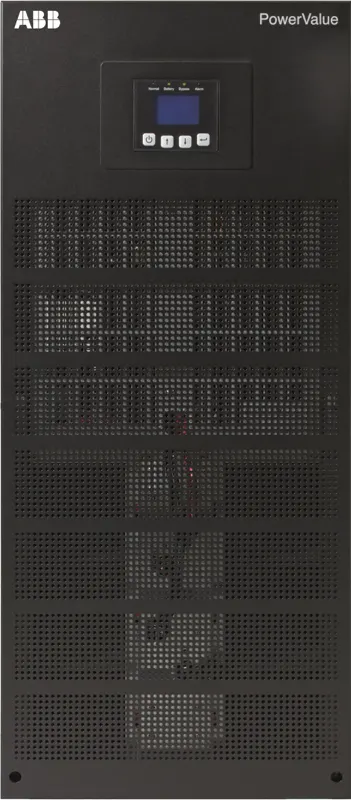
Technical specification
| Model code | Power | Input / output voltage | Phases | Topology | Efficiency | Dimensions W×D×H (mm) | Weight | Parallel / redundancy | Battery type |
|---|---|---|---|---|---|---|---|---|---|
| PowerValue 11/31 T 10 kVA | 10 kVA / 9 kW | Giris 1F+N 220/230/240 V veya 3F+N 380/400/415 V; cikis 208/220/230/240 V | Single-phase in + N or three-phase in + N; single-phase out | On-line, transformer-free; VFI-SS-111 | – | 350 × 715 × 890 | 56.3 kg (without batteries) | Up to 4 frames (to 80 kVA) | 12 V VRLA, with or without internal batteries |
| PowerValue 11/31 T 20 kVA | 20 kVA / 18 kW | Giris 1F+N 220/230/240 V veya 3F+N 380/400/415 V; cikis 208/220/230/240 V | Single-phase in + N or three-phase in + N; single-phase out | On-line, transformer-free; VFI-SS-111 | – | 350 × 715 × 890 | 66.8 kg (without batteries) | Up to 4 frames (to 80 kVA) | 12 V VRLA, with or without internal batteries |
Source of the values: ABB PowerValue 11/31 T 10-20 kVA teknik sartname (4NWD002980 REV-D). The PowerValue 11 RT range covers 1-10 kVA in a rack/tower frame; its figures are supplied on request. An en dash means the manufacturer does not publish that value; we do not fill it in with an estimate. Confirm every figure against the current manufacturer document before it is written into a contract.
The references we quote in this family are PowerValue 11/31 T 10 kVA and PowerValue 11/31 T 20 kVA. Send us the reference if you already have one, or the load in kW and the runtime if you do not, and we will confirm availability and lead time.
Which one should you choose?
The numbers are phases, not a model year
11 means single-phase in, single-phase out. 31 means three-phase in, single-phase out. A site with a three-phase supply and single-phase loads is exactly what the 31 T is for, and choosing 11 there wastes the balanced supply you already have.
Where 31 T earns its place
Taking three-phase input and delivering single-phase output balances the draw across the phases rather than loading one. In a building where the distribution board is already close to its limit on one phase, that alone can avoid an upgrade to the incoming supply.
Twenty kVA and the class boundary
This is small-room equipment: a communications cabinet, a control room, a clinic. Above 20 kVA the installation becomes an electrical project with its own switchgear. If your load is close to the boundary, settle which side it falls on before comparing prices.
Small does not mean unmonitored
A unit in a cupboard is the one nobody checks until it fails. Specify at least basic network monitoring so that a failed battery reports itself rather than being discovered during the outage it was bought to cover. The card costs a fraction of one avoided incident.
Ventilation in a cupboard
Units in this class often end up in a cabinet or under a desk with no thought given to airflow. Leave clearance around the unit and remember that a warm cupboard can halve battery life. Deciding the location before ordering is cheaper than paying for an early battery replacement two years later.
Where it fits, and where it does not
Fits a small server room, control room or communications cabinet under 20 kVA, and specifically fits a site with a three-phase supply and single-phase loads. Does not fit a data hall or any three-phase output requirement.
What we need in order to quote it
- Load in kVA and the input supply: single-phase or three-phase
- Whether the output must be single-phase
- Rack or tower installation and the space available
- Runtime target and battery arrangement
- Circuit rating and socket type at the point of connection
Request a Quote
Tell us the load in kW, the runtime you want and the delivery country. A priced quote comes back within 48 hours, usually with a second option so the trade-off is visible.