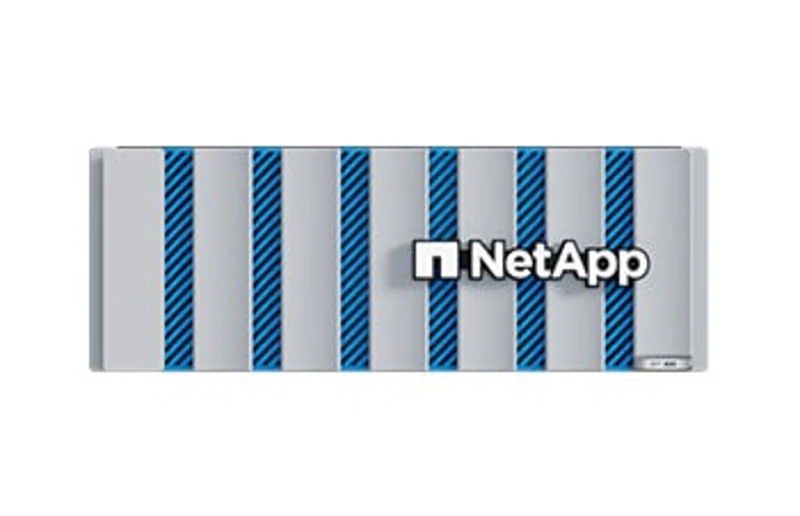
NetApp AFF A-Series: all-flash arrays from A20 to A1K
The current AFF A-Series is NetApp’s all-flash line, running from A20 at the entry to A1K at the top, with the family rated up to 40 million IOPS, 1 TB/s of throughput and 99.9999% availability. NetApp is the platform most often specified where file services and data management matter as much as raw block performance.
Technical specification
| Model | Type | Maximum capacity | Controller | Protocols | Drive type | Rack U |
|---|---|---|---|---|---|---|
| AFF A20 | All-flash unified storage | 37 PB effective (5:1) | Active-active pair; up to 576 SSDs | FC, iSCSI, NVMe/FC, NVMe/TCP, NFS, NFSv4/RDMA, SMB, S3 | SFF NVMe SSD (NS224 shelf) | 2U; 24 internal SSD slots |
| AFF A30 | All-flash unified storage | 54 PB effective (5:1) | Active-active pair; up to 864 SSDs | FC, iSCSI, NVMe/FC, NVMe/TCP, NFS, NFSv4/RDMA, SMB, S3 | SFF NVMe SSD (NS224 shelf) | 2U; 24 internal SSD slots |
| AFF A50 | All-flash unified storage | 92 PB effective (5:1) | Active-active pair; up to 1,440 SSDs | FC, iSCSI, NVMe/FC, NVMe/TCP, NFS, NFSv4/RDMA, SMB, S3 | SFF NVMe SSD (NS224 shelf) | 2U; 24 internal SSD slots |
| AFF A70 | All-flash unified storage | 185 PB effective (5:1) | Active-active pair; up to 2,880 SSDs | FC, iSCSI, NVMe/FC, NVMe/TCP, NFS, NFSv4/RDMA, SMB, S3 | SFF NVMe SSD (NS224 shelf) | 4U; 48 internal SSD slots |
| AFF A90 | All-flash unified storage | 185 PB effective (5:1) | Active-active pair; up to 2,880 SSDs | FC, iSCSI, NVMe/FC, NVMe/TCP, NFS, NFSv4/RDMA, SMB, S3 | SFF NVMe SSD (NS224 shelf) | 4U; 48 internal SSD slots |
| AFF A1K | All-flash unified storage | 185 PB effective (5:1) | Active-active pair; up to 2,880 SSDs | FC, iSCSI, NVMe/FC, NVMe/TCP, NFS, NFSv4/RDMA, SMB, S3 | SFF NVMe SSD (NS224 shelf) | 2 × 2U |
Source of the values: NetApp AFF A-Series technical specifications (2025). NetApp publishes effective capacity at a 5:1 storage efficiency ratio with the maximum number of SSDs installed, not raw capacity. Requires ONTAP 9.15.1 or later (9.16.1 for A20, A30 and A50). An en dash means the manufacturer does not publish that value; we do not fill it in with an estimate. Confirm every figure against the current manufacturer document before it is written into a contract.
The references we quote in this family are AFF A20, AFF A30, AFF A50, AFF A70, AFF A90 and AFF A1K. Send us the reference if you already have one, or the usable capacity and the protocol you need if you do not, and we will confirm availability and lead time.
The ONTAP version is part of the specification
Each controller in this family has a minimum ONTAP release: the AFF A70, A90 and A1K require ONTAP 9.15.1 or later, while the A20, A30 and A50 require 9.16.1 or later. That matters in two situations. If you are adding nodes to an existing cluster, the cluster has to reach the new node’s minimum version before the node can join, which turns a hardware purchase into a software upgrade project with its own change window. If you are buying a first system, the version sets the floor for the data services and the security features available to you on day one. Tell us the ONTAP release you run today and we will say whether the model you are considering can join the cluster as it stands or whether an upgrade has to be scheduled first.
Which one should you choose?
Choose on the data services, not only the media
Every vendor in this class sells fast flash. What separates NetApp in most evaluations is the data management layer: snapshots, replication, tiering and the way the same volume is presented to different protocols. If those features are in your requirement, the comparison is not really about IOPS.
Where each model sits
A20, A30 and A50 cover the entry and mid range and suit a single site or a departmental estate. A70 and A90 are the mainstream enterprise models. The A1K is the top of the family and is specified where the headline figures for the family actually apply. Size for the end of the refresh cycle.
The published maxima are family figures
40 million IOPS and 1 TB/s describe what the family can reach in its largest configuration, not what an A20 delivers. Read them as the ceiling of the platform rather than as a per-model promise, and ask for the figure at your configuration before comparing vendors.
Availability is a design, not a model number
A 99.9999% figure assumes a correctly designed and correctly operated installation, including the network, the power and the operational procedures. Buying the array does not deliver the number by itself. If the availability target is contractual, the design conversation has to happen before the purchase.
What we need from you
Usable capacity, protocols, performance target, replication requirement and whether this is a new estate or a refresh. On a refresh, the current array’s utilisation, snapshot policy and replication topology are the details that decide the sizing.
Request a Quote
Send the usable capacity, the protocol your hosts speak and the performance target. A priced quote comes back within 48 hours with the raw and usable figures separated.