NetApp FAS: hybrid flash arrays for secondary workloads
FAS is the hybrid member of the NetApp family: SSD and hard disk in the same system, ONTAP on top, and capacity published as raw rather than effective. The current line is FAS50, FAS70, FAS90 and FAS2820. It is aimed at backup targets, tiering destinations and cyber vaults rather than at latency-sensitive production.
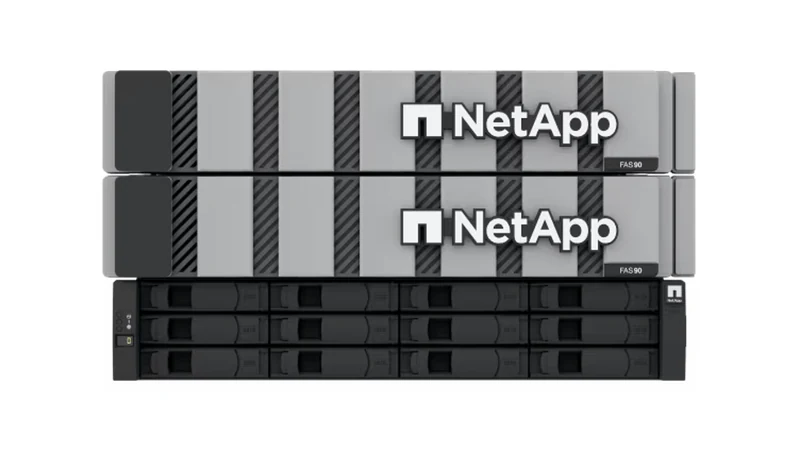
Technical specification
| Model | Type | Maximum capacity | Controller | Protocols | Drive type | Rack U |
|---|---|---|---|---|---|---|
| FAS50 | Hybrid flash storage | 10.6 PB raw per HA pair | Dual controller; up to 480 drives per HA pair; up to 24 NAS nodes | FC, iSCSI, NFS, SMB | SSD and HDD | 2U |
| FAS70 | Hybrid flash storage | 14.7 PB raw per HA pair | Dual controller; up to 1,440 drives per HA pair; up to 24 nodes | FC, iSCSI, NFS, SMB | SSD and HDD | 4U (2 × 2U) |
| FAS90 | Hybrid flash storage | 14.7 PB raw per HA pair | Dual controller; up to 1,440 drives per HA pair; up to 24 nodes | FC, iSCSI, NFS, SMB | SSD and HDD | 4U (2 × 2U) |
| FAS2820 | Hybrid flash storage | 2.3 PB raw per HA pair | Dual controller; up to 144 drives per HA pair | FC, iSCSI, NFS, SMB | SSD and HDD | 2U |
Source of the values: NetApp FAS storage arrays datasheet (DS-4020-0125). All figures are for dual-controller active-active HA pairs. Maximum raw capacity depends on the drive sizes offered at the time of order. An en dash means the manufacturer does not publish that value; we do not fill it in with an estimate. Confirm every figure against the current manufacturer document before it is written into a contract.
The references we quote in this family are FAS50, FAS70, FAS90 and FAS2820. Send us the reference if you already have one, or the usable capacity and the protocol you need if you do not, and we will confirm availability and lead time.
Which one should you choose?
Raw, for once
Unlike the all-flash families, NetApp publishes FAS capacity as maximum raw per HA pair: 14.7 PB on FAS70 and FAS90, 10.6 PB on FAS50 and 2.3 PB on FAS2820. That makes comparison across vendors easier, because raw is raw. It also means you must apply your own reduction assumption to reach a usable figure.
HA pair is the unit of sizing
Every published figure in our table is per HA pair, meaning two controllers in an active-active configuration. A cluster is built from HA pairs, so cluster capacity is a multiple. Read the numbers with that in mind when a quotation looks unexpectedly large or small.
Drive count is the other ceiling
FAS70 and FAS90 take up to 1,440 drives per HA pair, FAS50 up to 480 and FAS2820 up to 144. Capacity and drive count move together but not proportionally, because drive sizes differ. If the plan involves many small drives for parallelism, the drive ceiling binds before the capacity ceiling does.
Hybrid is a cost decision with a performance consequence
Mixing SSD and disk gives cheaper terabytes than all-flash and slower worst-case latency. For a backup landing zone or an archive tier that trade is correct. For a production database it is not, and the conversation should move to AFF or ASA.
The same ONTAP, which is the point
FAS runs the same operating system as the all-flash families, so replication from an AFF production system to a FAS secondary system is a native relationship rather than a third-party job. If you already run ONTAP, this is usually why FAS is on the list at all.
Where it fits, and where it does not
Fits a backup target, a tiering destination, a cyber vault or a secondary site replicating from an all-flash primary. Does not fit a latency-sensitive production workload, and does not fit a site with no ONTAP anywhere, where the operational argument disappears.
What we need in order to quote it
- Raw capacity required per HA pair and cluster size
- Whether an AFF or ASA primary will replicate to it
- Drive mix: how much flash is needed for the active tier
- Rack units and power available
- Retention period and immutability requirements
Request a Quote
Tell us the usable capacity, the protocol and the delivery country. A priced quote comes back within 48 hours, usually with a second option so the trade-off is visible.