Dell PowerScale: scale-out NAS from one node up
PowerScale is Dell’s scale-out NAS platform. Capacity and performance both grow by adding nodes to a cluster rather than by replacing a controller, and the cluster presents one namespace however many nodes are in it. The F nodes are all-flash, the A nodes are archive, the H nodes are hybrid. A cluster starts at three nodes and scales to 252.
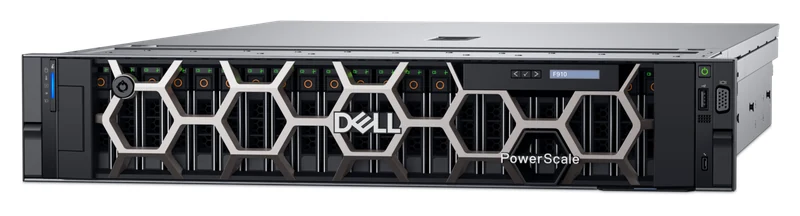
Technical specification
| Model | Type | Maximum capacity | Controller | Protocols | Drive type | Rack U |
|---|---|---|---|---|---|---|
| F210 | Scale-out NAS | 8 TB to 61 TB raw per node | One node per chassis; minimum three nodes per cluster | NFS, SMB, S3, HDFS | NVMe SSD | 1U |
| F710 | Scale-out NAS | 38 TB to 614 TB raw per node; up to 154 PB raw per cluster | One node per chassis; minimum three nodes per cluster | NFS, SMB, S3, HDFS | NVMe SSD | 1U |
| F910 | Scale-out NAS | – | One node per chassis; minimum three nodes per cluster | NFS, SMB, S3, HDFS | NVMe SSD | 2U |
| A300 | Scale-out NAS, archive | 120 TB to 1.2 PB per chassis; up to 75 PB per cluster | One node per chassis; minimum three nodes per cluster | NFS, SMB, S3, HDFS | HDD with SSD cache | – |
| A3000 | Scale-out NAS, archive | Up to 1.6 PB per chassis; up to 100 PB per cluster | One node per chassis; minimum three nodes per cluster | NFS, SMB, S3, HDFS | HDD with SSD cache | – |
| H700 | Scale-out NAS, hybrid | – | One node per chassis; minimum three nodes per cluster | NFS, SMB, S3, HDFS | HDD with SSD cache | – |
Source of the values: Dell PowerScale All-Flash specification sheet (H15963) and PowerScale data sheet (H10541). Maximum cluster size is 252 nodes. An en dash means the manufacturer does not publish that value; we do not fill it in with an estimate. Confirm every figure against the current manufacturer document before it is written into a contract.
The references we quote in this family are F210, F710, F910, A300, A3000 and H700. Send us the reference if you already have one, or the usable capacity and the protocol you need if you do not, and we will confirm availability and lead time.
Which one should you choose?
Node class is the first decision
F, A and H are not performance grades of the same thing; they are different media strategies. F nodes are all-flash for active data. A nodes hold archive data on high-capacity disk with flash cache. H nodes sit between the two. A cluster can mix them, which is usually the right answer once data ages, but the first purchase should match the data that exists today.
Three nodes is a floor, not a recommendation
The minimum cluster is three nodes because the file system needs that many to protect data. Three is a starting point for a small cluster, not a target. If you expect to grow, the cheaper path is usually a slightly larger node count at the start rather than a forklift later, because adding nodes is non-disruptive but re-platforming is not.
Capacity is quoted per node and per cluster
The published figures separate the two. An F710 node carries 38 TB to 614 TB raw, and a cluster of them reaches 154 PB raw. An A300 chassis carries 120 TB to 1.2 PB and scales to 75 PB per cluster. When you compare offers, check which number you are looking at, because per-node and per-cluster figures differ by two orders of magnitude.
Protocol breadth is the reason people choose it
PowerScale serves NFS, SMB, S3 and HDFS from the same namespace. That matters when a media pipeline, a Linux compute farm and a Windows department all need the same data without copies. If your requirement is a single protocol to a single application, a smaller unified array is usually cheaper.
Rack and power add up across nodes
F210 and F710 are 1U each, F910 is 2U. A cluster of twelve 1U nodes is twelve rack units plus switching, and the power draw scales with it. Scale-out capacity is easy to plan on paper and easy to under-plan in the room. Send us the target capacity and we will give you the node count, the rack units and the power before you commit to a layout.
Where it fits, and where it does not
Fits unstructured data that grows unpredictably: media, research, analytics, engineering files, anywhere one namespace across many protocols is worth more than raw speed. Does not fit a transactional database, which wants block storage, and does not fit a site with only a few terabytes, where a cluster is more machinery than the problem needs.
What we need in order to quote it
- Usable capacity today and growth rate per year
- Protocols the clients speak: NFS, SMB, S3 or HDFS
- How much of the data is active versus archive
- Rack units and power available for the cluster
- Whether an existing cluster will be extended or a new one built
Request a Quote
Tell us the usable capacity, the protocol and the delivery country. A priced quote comes back within 48 hours, usually with a second option so the trade-off is visible.