Dell PowerMax: high-end enterprise arrays, 2500 and 8500
PowerMax is Dell’s high-end array, the tier above PowerStore, built for open systems, mainframe and IBM i workloads on the same platform. Two models cover the range: the 2500 scales from two to four nodes, the 8500 from two to sixteen. Both are quoted in effective petabytes rather than raw, and both sit in a 3U form factor per the manufacturer’s published comparison.
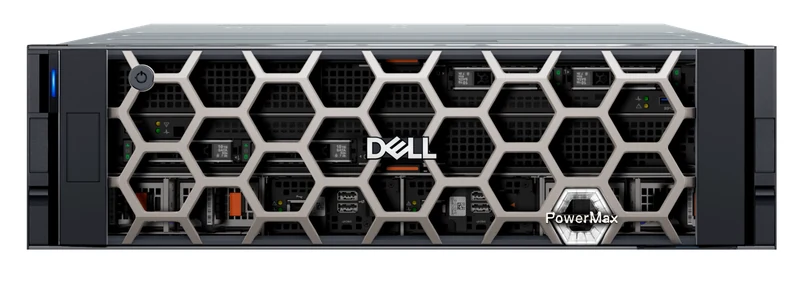
Technical specification
| Model | Type | Maximum capacity | Controller | Protocols | Drive type | Rack U |
|---|---|---|---|---|---|---|
| PowerMax 2500 | Enterprise high-end block and file | Up to 8 PBe (effective) | 2 or 4 nodes per array | NVMe/TCP (end-to-end NVMe) | – | 3U |
| PowerMax 8500 | Enterprise high-end block and file | Up to 18 PBe (effective) | 2 up to 16 nodes per array | NVMe/TCP (end-to-end NVMe) | – | 3U |
Source of the values: Dell PowerMax product page comparison table. Data reduction guarantee is 5:1 for open systems and 3:1 for mainframe; effective capacity assumes that ratio. An en dash means the manufacturer does not publish that value; we do not fill it in with an estimate. Confirm every figure against the current manufacturer document before it is written into a contract.
The references we quote in this family are PowerMax 2500 and PowerMax 8500. Send us the reference if you already have one, or the usable capacity and the protocol you need if you do not, and we will confirm availability and lead time.
Which one should you choose?
Node count is the difference that matters
The 2500 and the 8500 are the same platform at different scales. The 2500 takes two or four nodes and is quoted to 8 PBe. The 8500 takes up to sixteen nodes and is quoted to 18 PBe. If the growth curve is uncertain, the node ceiling is the specification to check, not today’s capacity.
Effective, not raw
Dell publishes PowerMax capacity as effective petabytes on a guaranteed data reduction ratio: 5:1 for open systems and 3:1 for mainframe. The number in the table is therefore a post-reduction figure. If your data does not reduce, and encrypted or pre-compressed data often does not, the usable number is lower. Ask for a sizing against your own data profile before you sign.
Mainframe changes the conversation
PowerMax is one of a small number of arrays that serves mainframe and open systems from the same box. If you have a mainframe, that single fact usually decides the platform. If you do not, you are paying for a capability you will not use and a mid-range array will cost considerably less.
Latency claims need a workload behind them
The published response time is under 60 microseconds. That figure describes the array under the manufacturer’s conditions, not your application through your fabric. Treat it as an upper bound on what the storage layer contributes, then measure the path. Most disappointing storage projects are disappointing in the network, not the array.
Plan the upgrade path, not just the purchase
A high-end array is a five to seven year commitment, and the cost of getting the class wrong is not the difference in list price, it is a migration. If the workload is close to the boundary between a mid-range and a high-end platform, ask for both to be sized so the comparison is on paper rather than in hindsight.
Where it fits, and where it does not
Fits an enterprise data centre with mainframe or IBM i alongside open systems, or a consolidation where one platform must carry everything with a hard availability requirement. Does not fit a mid-size site with a single hypervisor estate; PowerStore covers that at a fraction of the cost.
What we need in order to quote it
- Workload types: open systems, mainframe, IBM i or a mix
- Usable capacity after reduction, and the data profile behind it
- Node count expected at the start and at year three
- Protocols and fabric already in place
- Availability target and whether a second site is in scope
Request a Quote
Tell us the usable capacity, the protocol and the delivery country. A priced quote comes back within 48 hours, usually with a second option so the trade-off is visible.