Huawei OceanStor Pacific: distributed scale-out storage
OceanStor Pacific is Huawei’s distributed storage family for mass unstructured data. Capacity comes from chassis density rather than from a controller pair: the 9520 holds one node in 2U, the 9540 one node in 4U, and the 9550 two nodes in 5U with a published raw capacity of 720 TB to 2,400 TB per chassis. Huawei states the 9550 reduces required cabinet space by 62.5% against general-purpose storage servers.
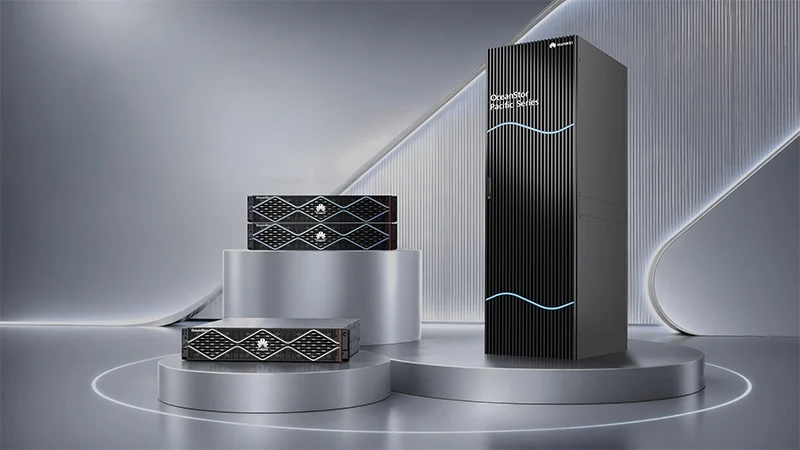
Technical specification
| Model | Type | Maximum capacity | Controller | Protocols | Drive type | Rack U |
|---|---|---|---|---|---|---|
| OceanStor Pacific 9520 | Hybrid scale-out storage | 84 TB to 336 TB raw per chassis | One storage node per chassis | – | High-capacity HDD | 2U (1 storage node) |
| OceanStor Pacific 9540 | Large-capacity hybrid scale-out storage | 216 TB to 864 TB raw per chassis | One storage node per chassis | – | High-capacity HDD | 4U (1 storage node) |
| OceanStor Pacific 9550 | Ultra-high-density hybrid storage | 720 TB to 2,400 TB raw per chassis | Two storage nodes per chassis | – | High-capacity HDD | 5U (2 storage nodes) |
Source of the values: Huawei OceanStor Pacific scale-out storage data sheet. The 9550 reduces required cabinet space by 62.5% compared with general-purpose storage servers, as published by the manufacturer. An en dash means the manufacturer does not publish that value; we do not fill it in with an estimate. Confirm every figure against the current manufacturer document before it is written into a contract.
The references we quote in this family are OceanStor Pacific 9520, OceanStor Pacific 9540 and OceanStor Pacific 9550. Send us the reference if you already have one, or the usable capacity and the protocol you need if you do not, and we will confirm availability and lead time.
Which one should you choose?
Density is the whole argument
For mass unstructured data the cost driver is not the controller, it is how many terabytes fit in a cabinet and what it costs to power and cool them. The three models are three points on that curve. Comparing them on IOPS misses what the family is for.
Chassis, node and cluster are three different numbers
Our table gives raw capacity per chassis. A 9550 chassis holds two nodes, a 9540 holds one. Cluster capacity is a multiple of chassis count and is limited by the network and the failure domain design, not by the enclosure. When comparing offers, check which of the three a number refers to.
HDD is a deliberate choice here
The family uses large-capacity hard disks as main storage. For petabyte-scale archives, media libraries and backup landing zones that is the economically correct medium; flash would multiply the cost without changing the outcome for sequential workloads.
Floor loading is the constraint people forget
A 5U chassis filled with large disks is heavy, and a cabinet of them is heavier. Density that saves cabinet space transfers the problem to the floor and to the cooling. Confirm the structural limit and the per-cabinet power budget before ordering the dense model.
Growth is horizontal, so plan the network
Distributed storage grows by adding chassis, which means the switching fabric grows with it. The storage quotation is only part of the cost. Tell us the target capacity and we will tell you the chassis count and the ports it implies, so the network budget is on the table from the start.
Where it fits, and where it does not
Fits petabyte-scale unstructured data: media archives, research datasets, video surveillance retention and backup landing zones. Does not fit a transactional database or a latency-sensitive virtualisation estate, where Dorado is the right family.
What we need in order to quote it
- Target raw capacity and annual growth
- Access pattern: sequential or random, and the protocol
- Cabinet space, floor loading limit and power per cabinet
- Network fabric available for a scale-out cluster
- Retention policy and whether a second site is required
Request a Quote
Tell us the usable capacity, the protocol and the delivery country. A priced quote comes back within 48 hours, usually with a second option so the trade-off is visible.