Huawei OceanProtect: backup and archive storage
OceanProtect is Huawei’s dedicated backup storage family. It is quoted in backup bandwidth rather than in capacity: the published figures run from 6.2 TB per hour on the X6000 to 155 TB per hour on the X9000, with a data reduction ratio published as up to 72:1. The architecture is active-active, with front-end protocol offload to keep CPU free for the backup stream.
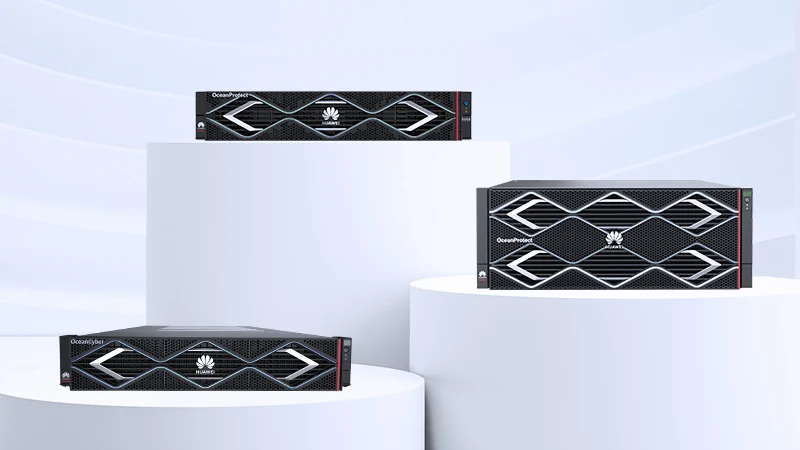
Technical specification
| Model | Type | Maximum capacity | Controller | Protocols | Drive type | Rack U |
|---|---|---|---|---|---|---|
| OceanProtect X6000 | Backup and archive storage | 6.2 TB/hour backup bandwidth | Active-active high-reliability architecture | – | – | – |
| OceanProtect X8000 | Backup and archive storage | – | Active-active high-reliability architecture | – | – | – |
| OceanProtect X9000 | Backup and archive storage | Up to 155 TB/hour backup bandwidth | Active-active high-reliability architecture | – | – | – |
Source of the values: Huawei OceanProtect X3000/X6000/X8000/X9000 backup storage data sheet. Published data reduction ratio is up to 72:1. The datasheet states bandwidth rather than raw capacity for this family. An en dash means the manufacturer does not publish that value; we do not fill it in with an estimate. Confirm every figure against the current manufacturer document before it is written into a contract.
The references we quote in this family are OceanProtect X6000, OceanProtect X8000 and OceanProtect X9000. Send us the reference if you already have one, or the usable capacity and the protocol you need if you do not, and we will confirm availability and lead time.
Which one should you choose?
Bandwidth, not terabytes, is the sizing input
A backup target is sized by how much data must land inside the backup window, not by how much it eventually holds. Divide the nightly change volume by the window in hours and compare that against the published TB per hour. A larger box with the wrong bandwidth still misses the window.
Restore speed matters more than backup speed
Backups run on a schedule; restores run on the worst day of the year. The published bandwidth figures describe the platform, but the number that decides whether a recovery meets its objective is the restore path end to end, including the network and the application. Test it before you need it.
A 72:1 ratio is a ceiling, not a plan
Published reduction ratios assume highly repetitive backup data. Your ratio depends on what you back up and how often. Size the landing capacity on a conservative assumption and treat anything better as headroom, because a reduction shortfall shows up as a full array in month four.
Immutability is a requirement, not a feature
The family publishes WORM anti-tampering, anti-deletion and air-gap capabilities. For any organisation with a ransomware clause in its insurance or its regulation, these are the properties the auditor asks about. Decide the retention and immutability policy before the hardware, because it changes the capacity you need.
It sits beside primary storage, not instead of it
OceanProtect is a backup target. It does not replace the production array and it is not sized like one. If a single platform is expected to serve both production and backup, the design usually fails one of the two requirements. Keep them separate and size each against its own objective.
Where it fits, and where it does not
Fits an organisation with a defined backup window, a retention policy and a ransomware requirement, backing up databases, virtual machines and file shares. Does not fit as primary storage, and does not fit a site whose backup problem is really a software problem rather than a target problem.
What we need in order to quote it
- Nightly change volume and the backup window in hours
- Total retention required and for how long
- Backup software already in use
- Immutability, WORM or air-gap requirements
- Restore time objective for the most critical system
Request a Quote
Tell us the usable capacity, the protocol and the delivery country. A priced quote comes back within 48 hours, usually with a second option so the trade-off is visible.