Huawei OceanStor Dorado: end-to-end NVMe all-flash
OceanStor Dorado is Huawei’s all-flash family, built on an end-to-end NVMe architecture and the SmartMatrix fully interconnected controller design. The published headline is up to 20,000,000 IOPS at the top of the range and a controller architecture that tolerates the failure of seven controllers out of eight. The family runs from Dorado 2000 at the entry to Dorado 18000 at the top.
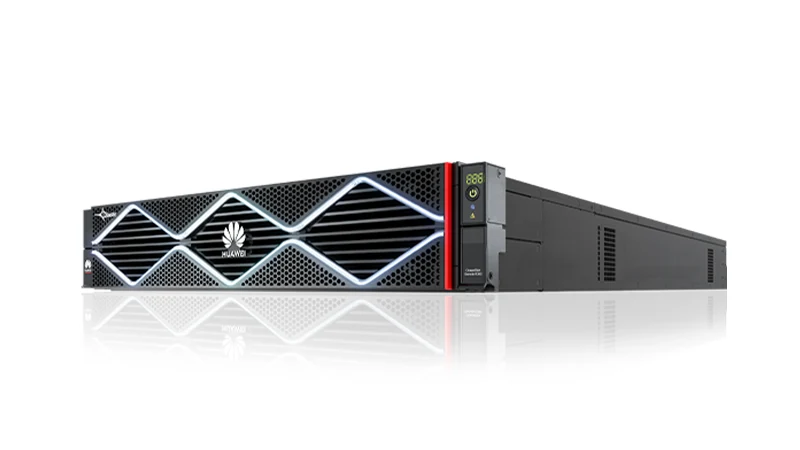
Technical specification
| Model | Type | Maximum capacity | Controller | Protocols | Drive type | Rack U |
|---|---|---|---|---|---|---|
| Dorado 2000 | All-flash, end-to-end NVMe | – | SmartMatrix fully interconnected architecture; up to 32 controllers; tolerates failure of 7 of 8 controllers | – | Dual-port NVMe SSD, hot swap | – |
| Dorado 3000 | All-flash, end-to-end NVMe | – | SmartMatrix fully interconnected architecture; up to 32 controllers; tolerates failure of 7 of 8 controllers | – | Dual-port NVMe SSD, hot swap | – |
| Dorado 5000 | All-flash, end-to-end NVMe | – | SmartMatrix fully interconnected architecture; up to 32 controllers; tolerates failure of 7 of 8 controllers | – | Dual-port NVMe SSD, hot swap | – |
| Dorado 6000 | All-flash, end-to-end NVMe | – | SmartMatrix fully interconnected architecture; up to 32 controllers; tolerates failure of 7 of 8 controllers | – | Dual-port NVMe SSD, hot swap | – |
| Dorado 8000 | All-flash, end-to-end NVMe | – | SmartMatrix fully interconnected architecture; up to 32 controllers; tolerates failure of 7 of 8 controllers | – | Dual-port NVMe SSD, hot swap | – |
| Dorado 18000 | All-flash, end-to-end NVMe | – | SmartMatrix fully interconnected architecture; up to 32 controllers; tolerates failure of 7 of 8 controllers | – | Dual-port NVMe SSD, hot swap | – |
Source of the values: Huawei OceanStor Dorado V6 datasheet. The datasheet we hold describes the family architecture (up to 20,000,000 IOPS, 2U 36-slot SSD enclosures) but does not publish per-model capacity tables. An en dash means the manufacturer does not publish that value; we do not fill it in with an estimate. Confirm every figure against the current manufacturer document before it is written into a contract.
The references we quote in this family are Dorado 2000, Dorado 3000, Dorado 5000, Dorado 6000, Dorado 8000 and Dorado 18000. Send us the reference if you already have one, or the usable capacity and the protocol you need if you do not, and we will confirm availability and lead time.
Which one should you choose?
The redundancy claim is the differentiator
Most arrays survive one controller failure. Huawei publishes tolerance of seven controller failures out of eight, and of one controller enclosure out of two, without service interruption. If your availability requirement is written into a contract rather than an aspiration, this is the specification to put in front of the auditor.
Model number is a class, not a feature list
Dorado 2000 through 18000 share the architecture and differ in controller count, cache and scale. Moving up the range buys headroom rather than capabilities. That makes sizing straightforward but it also means an undersized choice cannot be fixed with a licence.
End-to-end NVMe is about the whole path
The phrase means NVMe from the host interface through the controller to the drive, not simply NVMe drives behind a SAS controller. That is what removes the latency floor that SAS-based all-flash arrays run into. It also means the host side must be able to use it; an NVMe array behind an old fabric delivers old numbers.
Density affects the room, not just the rack
Huawei publishes 2U enclosures with 36 SSD slots. High density is attractive until the floor loading and the cooling are checked, because a fully populated dense rack concentrates both. Confirm the per-rack power and weight budget before the layout is fixed.
We publish only what the manufacturer publishes
The Dorado datasheet we hold describes the architecture rather than a per-model capacity table, so several cells in our table are blank. That is deliberate. Send us the capacity, the protocol and the availability target and we will obtain the model-level specification from the manufacturer before quoting.
Where it fits, and where it does not
Fits a data centre where availability is contractual and latency is measured: banking, carrier, government and manufacturing workloads on databases and virtualisation. Does not fit an archive or a backup target, where cost per terabyte governs and OceanProtect or Pacific is the right family.
What we need in order to quote it
- Usable capacity and the data reduction you can rely on
- Latency target and the application behind it
- Host fabric: NVMe/FC, NVMe/TCP, FC or iSCSI
- Availability requirement and whether it is contractual
- Rack power, weight and cooling budget per cabinet
Request a Quote
Tell us the usable capacity, the protocol and the delivery country. A priced quote comes back within 48 hours, usually with a second option so the trade-off is visible.