HPE ProLiant DL Gen11 (Intel): 1U, 2U and 4U rack servers
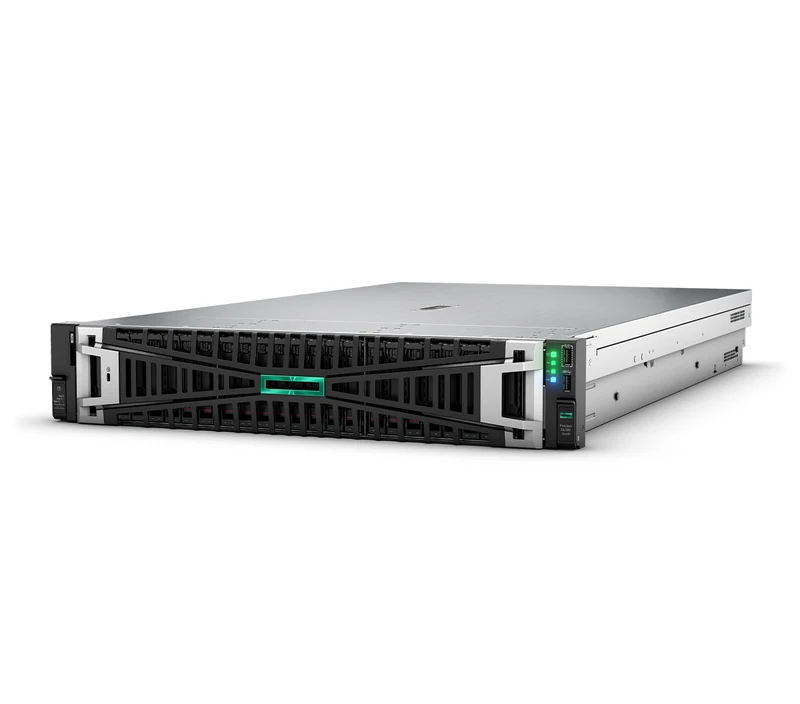
The ProLiant DL Gen11 Intel line runs 4th generation Xeon Scalable across the entry DL320, the dense DL360 (1U, up to 60 cores), the flexible DL380 (2U, up to 30 SFF drives), the GPU-focused DL380a, and the four-socket DL560. iLO 6 embedded management and the Silicon Root of Trust security anchor are common across the whole Gen11 generation.
Technical specification
| Model | Form factor | Socket / processor generation | Max memory | Drive bays | GPU support | Power supply | Network |
|---|---|---|---|---|---|---|---|
| DL320 Gen11 | 1U | 1x, single-socket | – | – | – | – | – |
| DL360 Gen11 | 1U | 2x 4th Gen Intel Xeon Scalable, up to 60 cores | 16 DIMMs/socket, 8 TB total | Up to 8+2 SFF SAS/SATA/NVMe U.3 | Up to 2x single-wide | 800–2200 W Flex Slot, Platinum/Titanium | OCP 3.0, wide range of speeds |
| DL380 Gen11 | 2U | 4th Gen Intel Xeon Scalable Platinum/Gold/Silver/Bronze | Up to 4 TB/socket | Up to 30x SFF or 16x LFF | Up to 3x, varies by drive-cage count | 800–1600 W Flex Slot, Platinum/Titanium | 1/10/25 Gb OCP 3.0 |
| DL380a Gen11 | 2U | GPU-optimised variant of DL380 Gen11 | – | – | – | – | – |
| DL560 Gen11 | 4U | 4x, four-socket | – | – | – | – | – |
Source of the values: HPE ProLiant DL360 Gen11 datasheet. DL360 and DL380 Gen11 are documented in full from HPE’s own datasheet and QuickSpecs; the entry DL320, the GPU-optimised DL380a and the four-socket DL560 share the Gen11 platform but their individual configuration was not confirmed in the documents we hold. An en dash means the manufacturer does not publish that value in the source we hold; we do not fill it in with an estimate. Confirm every figure against the current manufacturer document before it is written into a contract.
The codes we quote in this family are DL320 Gen11, DL360 Gen11, DL380 Gen11, DL380a Gen11 and DL560 Gen11. Send us the workload and the constraints, and we will confirm availability, lead time and the exact configuration.
Which one should you choose?
DL360’s density is built around VDI and compute-dense workloads
1U with dual sockets and up to 60 cores per processor, DL360 Gen11 targets EDA, CAD and large-scale VDI where rack density per compute unit matters more than raw drive count. It takes up to 8+2 SFF drives, not the 30-drive maximum of DL380; do not choose DL360 for a storage-heavy role.
DL380’s drive flexibility spans four chassis types
DL380 Gen11 ships in 8SFF, 24SFF, 8LFF and 12LFF chassis variants from the same 2U platform, reaching up to 30 SFF or 16 LFF drives depending on configuration. Decide the drive count and type at order time; the chassis variant is fixed at the factory, not a field upgrade.
GPU count on DL380 depends on the drive cage, not just the chassis
With one drive cage installed, DL380 Gen11 can take up to three GPUs air-cooled; with three drive cages, GPU headroom drops to one. Direct liquid cooling restores the higher GPU count even with more drive cages. Plan the drive and GPU configuration together, not as two separate decisions.
DL320 and DL560 sit at opposite ends and were not individually confirmed here
DL320 is the entry single-socket 1U and DL560 the four-socket 4U; both share the Gen11 platform’s management and security features but their detailed drive, GPU and power figures were not in the documents we hold. Ask us to confirm before quoting either.
Where it fits, and where it does not
Fits a data hall standardising on HPE iLO management across compute-dense (DL360), storage-flexible (DL380) and four-socket (DL560) Intel tiers. Does not fit a workload needing AMD’s core-count economics; see the DL Gen11 (AMD) page for that.
What we need in order to quote it
- Compute-dense or storage-flexible role (DL360 vs DL380)
- Drive cage configuration and target GPU count together
- Whether direct liquid cooling is available in the room
- Four-socket requirement, if any
Request a Quote
Tell us the usable capacity, the protocol and the delivery country. A priced quote comes back within 48 hours, usually with a second option so the trade-off is visible.