Supermicro GPU SuperServer: 4U and 8U AI training chassis
SYS-821GE-TNHR is Supermicro’s flagship 8U GPU chassis, taking up to eight NVIDIA HGX H200 GPUs with full NVLink/NVSwitch interconnect on dual 5th/4th generation Xeon, with up to 8 TB of DDR5 and 6x/8x 3000 W Titanium PSUs. SYS-421GE-TNRT is the 4U alternative with up to ten dual-root PCIe GPUs; AS-8125GS-TNHR is the AMD equivalent of the 8U platform.
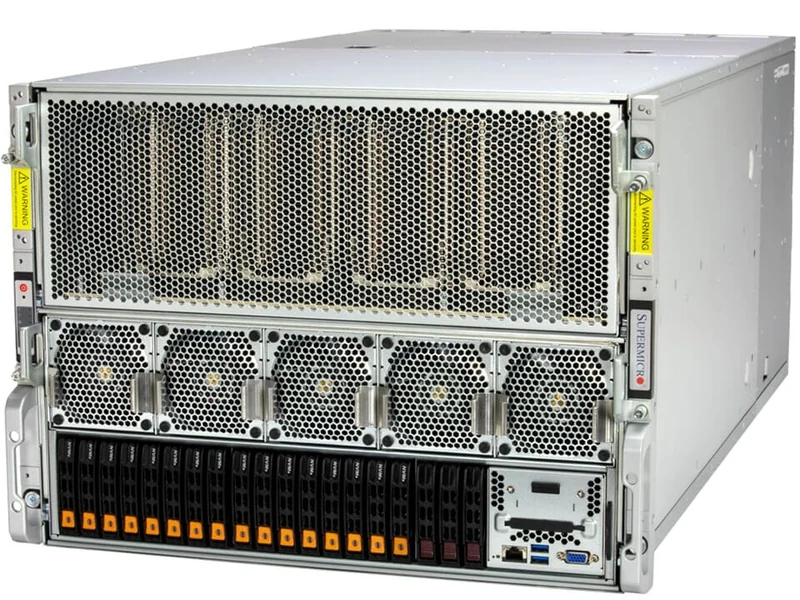
Technical specification
| Model | Form factor | Socket / processor generation | Max memory | Drive bays | GPU support | Power supply | Network |
|---|---|---|---|---|---|---|---|
| SYS-421GE-TNRT | 4U | 2x 4th Gen Intel Xeon Scalable | 32 DIMMs, up to 8 TB | – | Up to 10x PCIe GPU, dual-root | – | – |
| SYS-821GE-TNHR | 8U | 2x 5th/4th Gen Intel Xeon Scalable, up to 64 cores | 32 DIMMs, up to 8 TB DDR5-5600 | – | Up to 8x NVIDIA HGX H200, NVLink/NVSwitch | 6x 3000 W (4+2) or 8x 3000 W (4+4), Titanium | – |
| AS-8125GS-TNHR | 8U | 2x AMD EPYC | – | – | NVIDIA HGX H100/H200 8-GPU | – | – |
Source of the values: Supermicro SYS-421GE-TNRT/SYS-821GE-TNHR/AS-8125GS-TNHR product pages (supermicro.com). SYS-821GE-TNHR is documented in full from Supermicro’s own product page. SYS-421GE-TNRT and AS-8125GS-TNHR were confirmed for form factor, processor and GPU capacity only; drive bays are marked – because these are GPU-baseboard chassis with little to no internal drive capacity, not because the figure is simply unknown. An en dash means the manufacturer does not publish that value in the source we hold; we do not fill it in with an estimate. Confirm every figure against the current manufacturer document before it is written into a contract.
The codes we quote in this family are SYS-421GE-TNRT, SYS-821GE-TNHR and AS-8125GS-TNHR. Send us the workload and the constraints, and we will confirm availability, lead time and the exact configuration.
Which one should you choose?
8U HGX baseboard versus 4U dual-root PCIe is an interconnect decision, not just a size one
SYS-821GE-TNHR’s HGX baseboard gives full NVLink/NVSwitch interconnect between all eight GPUs, which large-model training needs. SYS-421GE-TNRT’s ten PCIe GPUs across dual roots give higher raw GPU count in less rack height but without the same GPU-to-GPU bandwidth; right for inferencing fleets, not for training a single large model across all ten.
Power supply configuration scales with GPU count, plan the circuit first
SYS-821GE-TNHR ships with 6x 3000 W (4+2) as standard and an 8x 3000 W (4+4) option for maximum redundancy; at full load this is a multi-tens-of-kW chassis. Confirm the room’s power feed and cooling capacity for this specific figure before the chassis goes into a proposal, not after.
AMD and Intel GPU chassis are not interchangeable on accelerator support
AS-8125GS-TNHR runs AMD EPYC processors alongside its NVIDIA HGX H100/H200 GPU baseboard, while SYS-821GE-TNHR and SYS-421GE-TNRT run Intel Xeon. The GPU baseboard choice is largely independent of the host CPU vendor, so pick the CPU platform based on the rest of the software stack’s requirements, not the GPU alone.
Drive bays are intentionally minimal on this line, plan storage separately
These are GPU-baseboard chassis built to maximise accelerator density and interconnect, not storage capacity; expect to pair them with a separate storage-dense server or array for training data and checkpoints rather than relying on local drive bays.
Where it fits, and where it does not
Fits large-model AI training that needs eight-GPU NVLink interconnect (SYS-821GE-TNHR/AS-8125GS-TNHR) or a higher raw GPU count in less rack height for inferencing fleets (SYS-421GE-TNRT). Does not fit a site without dedicated high-density power and cooling already confirmed, and does not fit a role needing significant local drive capacity.
What we need in order to quote it
- NVLink baseboard interconnect required, or PCIe acceleration sufficient
- Specific GPU model and count (H100, H200, MI-series)
- Room power feed confirmed against the PSU configuration
- Separate storage plan for training data and checkpoints
Request a Quote
Tell us the usable capacity, the protocol and the delivery country. A priced quote comes back within 48 hours, usually with a second option so the trade-off is visible.