HPE Alletra Server and Apollo 6500: AI and storage-dense compute
Alletra Storage Server 4110 (1U) and 4120 (2U) are HPE’s storage-dense compute nodes, taking up to 48 SFF or 24 LFF drives with PCIe Gen5 NVMe bandwidth and optional NVIDIA L4/A2 acceleration. Apollo 6500 (Gen10 Plus, the current shipping platform; see the note below) is the dedicated 4U GPU chassis, taking up to 16 NVIDIA H100 or AMD MI210 GPUs.
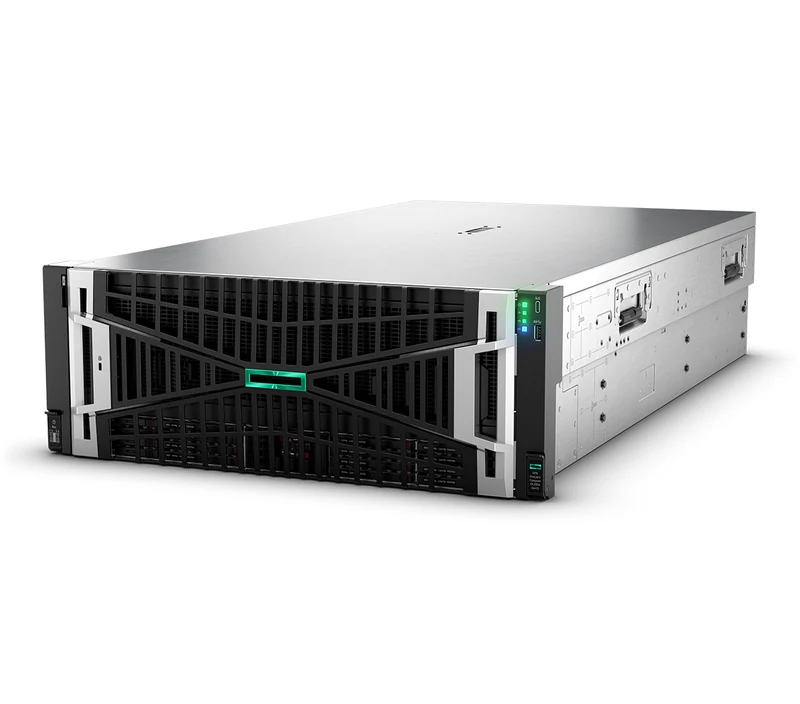
Technical specification
| Model | Form factor | Socket / processor generation | Max memory | Drive bays | GPU support | Power supply | Network |
|---|---|---|---|---|---|---|---|
| Alletra Storage Server 4110 | 1U | 2x Intel Xeon | Up to 3 TB DDR5 | Up to 20x EDSFF E3.S or SFF | GPU/FPGA support | – | – |
| Alletra Storage Server 4120 | 2U | 2x 4th/5th Gen Intel Xeon Scalable | Up to 3 TB DDR5 | Up to 48x SFF or 24x LFF | NVIDIA L4 / A2 | – | – |
| Apollo 6500 Gen10 Plus | 4U | 2x, GPU-dense | – | – | Up to 16x NVIDIA H100 or AMD MI210 | – | – |
Source of the values: HPE Alletra Storage Server 4110/4120 QuickSpecs; HPE Apollo 6500 Gen10 Plus QuickSpecs (hpe.com). Excel lists this row as “Apollo 6500 Gen11”; we could not confirm a Gen11 generation of Apollo 6500 exists. The current shipping platform is Apollo 6500 Gen10 Plus, and that is what we quote here (K-69 correction, logged separately). Confirm the exact generation with HPE before quoting. An en dash means the manufacturer does not publish that value in the source we hold; we do not fill it in with an estimate. Confirm every figure against the current manufacturer document before it is written into a contract.
The codes we quote in this family are Alletra Storage Server 4110, Alletra Storage Server 4120 and Apollo 6500 Gen10 Plus. Send us the workload and the constraints, and we will confirm availability, lead time and the exact configuration.
Which one should you choose?
A generation correction worth knowing before you quote
Our internal product list names this platform “Apollo 6500 Gen11”; we checked and could not confirm a Gen11 generation exists. The current shipping platform is Apollo 6500 Gen10 Plus, and that is the configuration described on this page. Confirm the exact generation with HPE before it goes into a contract.
4110 and 4120 are compute nodes with storage density, not storage arrays
Both Alletra Storage Server models run standard x86 processors and a hypervisor or software-defined storage stack; they are servers built for drive density, not a turnkey SAN/NAS appliance. If a turnkey storage array is what is actually needed, the Storage group’s Alletra 5000/6000 or MSA pages are the right quote.
4110 and 4120 differ mainly in drive count, not architecture
4110 is the compact 1U option at up to 20 EDSFF/SFF drives; 4120 doubles the rack height for up to 48 SFF drives. Choose based on the drive count the workload actually needs; both share the same PCIe Gen5 NVMe bandwidth per drive.
Apollo 6500’s GPU count is the reason to choose it over a DL380a
At up to 16 GPUs in one 4U chassis, Apollo 6500 targets large-scale training and HPC rather than the modest one-to-three-GPU acceleration a DL380a covers. If the requirement is genuinely a handful of GPUs for inferencing, the DL Gen11 line with GPU options is simpler to deploy and support.
Where it fits, and where it does not
Fits a storage-dense compute role (Alletra Storage Server) or large-scale GPU training (Apollo 6500 Gen10 Plus). Does not fit a workload needing a turnkey storage array; see the Storage group; and does not fit light GPU inferencing, where a DL380a is simpler and cheaper.
What we need in order to quote it
- Whether the role is compute with high drive density, or dedicated GPU training
- Drive count and protocol for Alletra Storage Server
- GPU model and count for Apollo 6500, confirmed against the current Gen10 Plus platform
- Power and cooling capacity for a 16-GPU chassis if Apollo 6500 is chosen
Request a Quote
Tell us the usable capacity, the protocol and the delivery country. A priced quote comes back within 48 hours, usually with a second option so the trade-off is visible.