A rack server is a server built to a fixed U height so that it mounts on the rails of a 19-inch cabinet, most commonly 1U, 2U or 4U. The height does not describe how fast the machine is. It describes what physically fits inside it: how many expansion cards, how many drive bays and how much airflow the cooling system can move.
What the U figure actually buys you
1U takes low-profile expansion cards and small, fast fans. It is the density choice: compute nodes in a virtualisation or HPC cluster, where the work is done by processors and memory and nothing much needs to be plugged in.
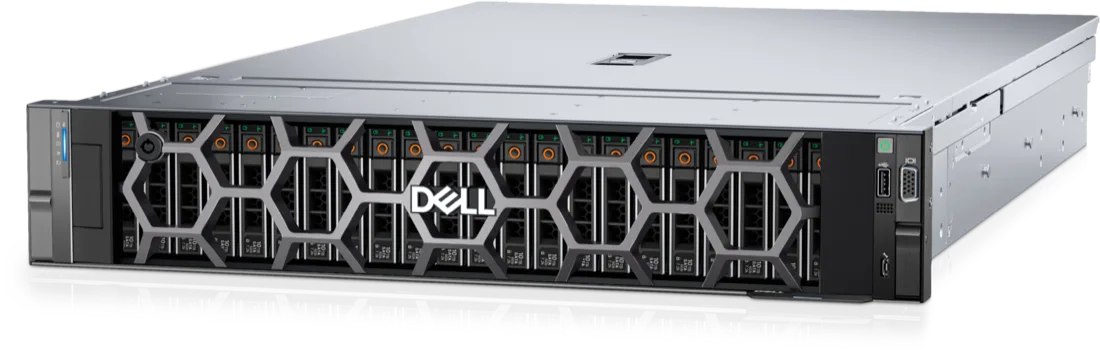
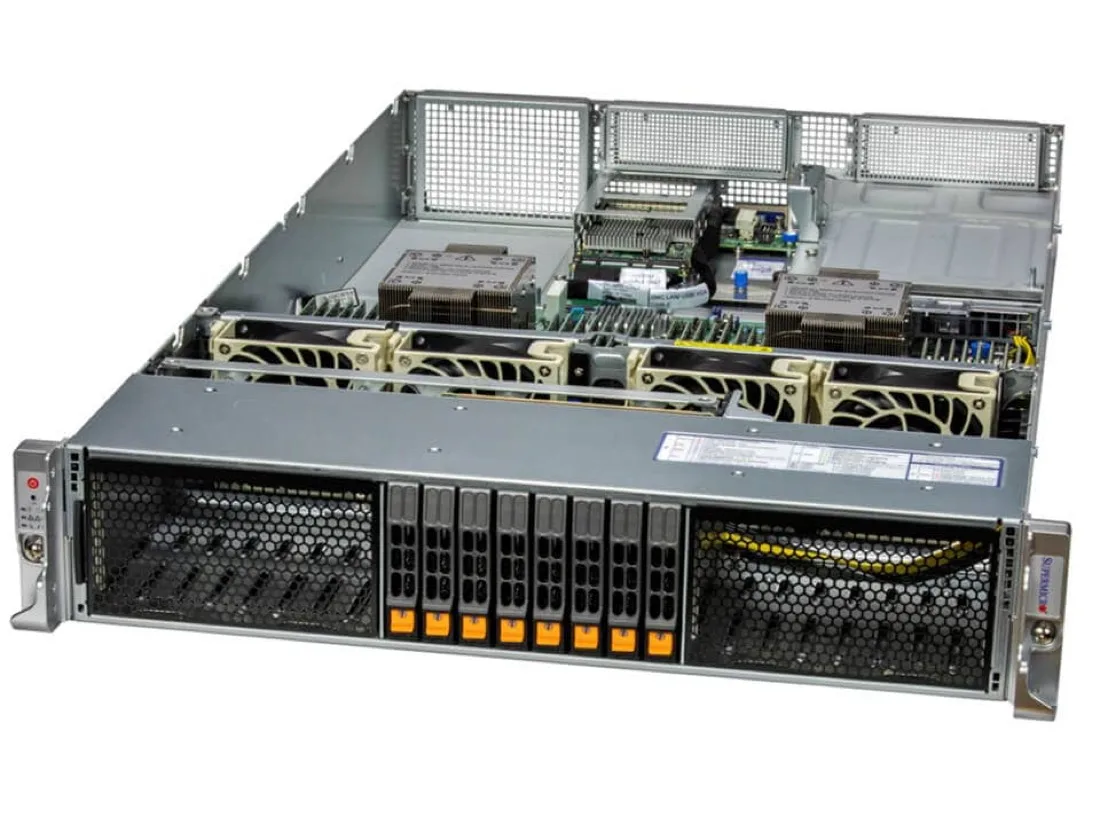
2U takes full-height cards, including most GPUs, more drive bays and larger fans that move air more efficiently and more quietly. It is the volume choice in most estates, and the extra rack unit usually pays for itself the first time you need to add a card.
4U is what you buy when the expansion or cooling requirement will not fit anywhere else: multiple full-length GPUs, very high drive counts, or processors at the top of the thermal range.
Choose the chassis from the card and drive count
The common mistake is to pick the chassis on price and then discover the configuration will not fit. Work in the other order. Count the expansion cards you need, count the drives, check the processor thermal design power, and let those three numbers choose the height. Then pick the processor and memory inside that chassis.
A 1U server that needs a full-height card is not a cheaper 2U server. It is a machine that cannot be built.
Rack economics: is 1U always denser
Not in practice. Density is limited by power and cooling per rack far more often than by rack units. A rack provisioned at 7 kW fills up after roughly fifteen to twenty typical 1U servers, which is well before you run out of U in a 42U cabinet.
Once power is the binding constraint, choosing 2U costs you nothing in usable capacity and buys expansion, better thermals and quieter operation. Work out your kW per rack first and the 1U versus 2U question usually answers itself.
Two sockets or one
Single-socket servers have become genuinely capable, and current processors offer enough cores that many workloads that once needed two sockets now do not. A single-socket machine is cheaper, simpler and often uses less power for the same delivered work.
Two sockets still win where memory bandwidth or total memory capacity is the constraint rather than core count, because the second socket brings its own memory channels. Four-socket machines are for large in-memory workloads and consolidation cases, and they cost disproportionately more per core, so the case has to be specific.
Configuration is the price, not the model
Two servers with the same model number can differ by a factor of several in price. The variables that move it are processor generation and core count, memory quantity and speed, drive type and capacity, network adapter speed, redundant power supplies and the support level.
| Choice | What it affects | Common mistake |
|---|---|---|
| Processor | Core count, clock, thermal design power | Buying cores a licence model then charges for |
| Memory | Capacity and bandwidth | Under-populating channels, losing bandwidth |
| Drives | Latency and endurance | Read-optimised media on a write-heavy workload |
| Network | Throughput and port count | Ordering a speed the switch cannot accept |
| Support | Response time and duration | Standard warranty on a machine that cannot be down |
Memory deserves the extra warning. Populating channels in the wrong pattern leaves bandwidth on the table, and an under-populated server is measurably slower than its specification suggests while looking identical on paper.
Tower servers still exist for a reason
A tower server suits a site with no cabinet: a branch office, a workshop, a small practice. It is quieter, it tolerates a normal room and it needs no rails. What it does not give you is cable discipline, front-to-back airflow or the ability to add a second machine without doubling the floor space.
If a cabinet is likely within two years, buying rack format now and racking it later is usually cheaper than replacing a tower.
What the rack has to provide
Before ordering, confirm three things about the cabinet. Depth, because a 2U server with a cable management arm needs more than the chassis figure suggests. Rail compatibility, because square-hole, round-hole and threaded rails are not interchangeable. Outlet type on the PDU, because larger servers use C19 rather than C13 and running out of the right outlet is solved by buying another PDU.
Lead time is part of the specification
Stocked configurations ship in days. A machine built to order with a specific processor, a large memory population and particular drives is manufactured, and that runs to weeks. GPU-equipped systems can run considerably longer depending on the accelerator.
If the project has a fixed date, ask for the lead time on the exact configuration rather than on the model, and ask whether a near-equivalent stocked build would meet the requirement. The difference between two similar configurations is often several weeks of delivery.
Redundant power supplies and dual feeds
Almost every rack server offers redundant power supplies, and they are worth having, but only if the two supplies are actually plugged into two independent feeds. A dual-corded server with both cords in the same PDU is a single-corded server with extra cable.
Check the power supply rating too. A server configured with high-TDP processors and several GPUs may need the higher-rated supply option, and fitting the lower one caps what you can install later without opening the machine again.
What to send with an enquiry
- The workload and how many nodes
- Storage arrangement: local drives, SAN or NAS
- Network speed and port count you need
- Rack space, depth and power available
- Support level and duration
- Whether the machines join an existing estate, and which platform
Our servers page lists the families we supply in 1U, 2U and 4U. If the storage side is still open, storage is the decision that usually travels with it.
Need a quote on this?
Send the load, the capacity and the delivery country. A priced quote comes back within 48 hours.
Request a Quote