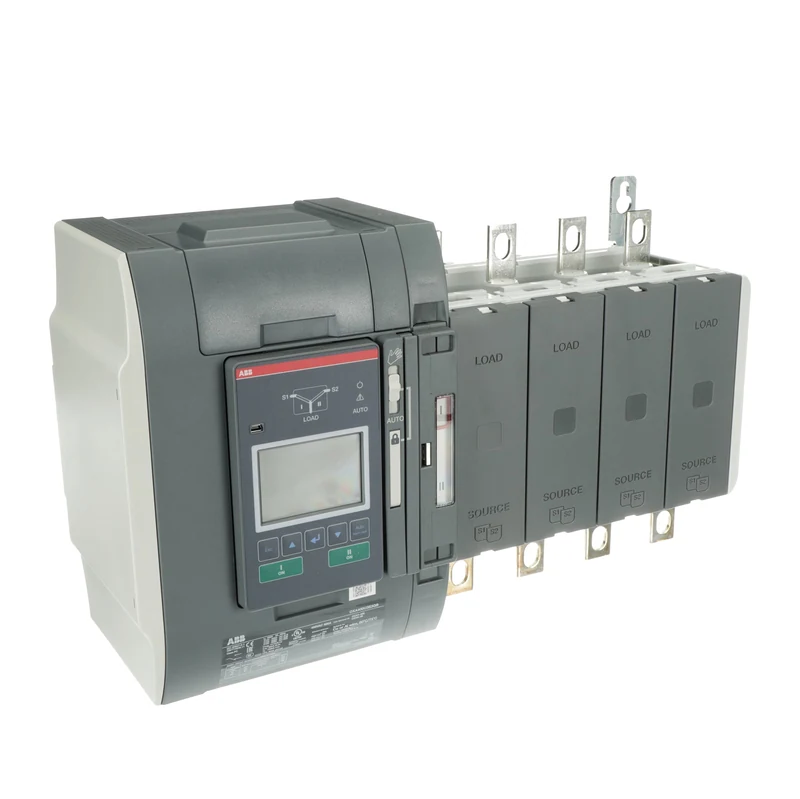
ABB TruONE: all-in-one automatic transfer switch, 30 to 1600 A
TruONE is ABB’s fully integrated ATS: switch, controller and HMI in one factory-tested unit spanning 30 to 1600 A (IEC) or 30 to 1200 A (UL), 200-480 V, single or three-phase, in 2, 3 or 4-pole configurations. Rather than a fixed catalogue number, the exact unit is specified through an order code that encodes size, standard, poles, control level and inlet direction.
Technical specification
| Model | Current | Poles | Voltage | Transfer time | Type | Mounting | Control / comms |
|---|---|---|---|---|---|---|---|
| OXB..E3S4QB (example, 1000 A) | 30–1600 A (IEC) / 30–1200 A (UL) | 2, 3 or 4 | 200–480 V | Open or delayed transition | Panel | Bottom or top inlet, open style | TruCONTROL Level 2/3/4 |
Source of the values: ABB TruONE ATS brochure and catalogue. TruONE is a build-to-order platform, not a fixed catalogue SKU list: the order code (e.g. OXB1000E3S4QB) encodes the ampere size, standard, phase/pole configuration, control level and inlet direction. The row above shows one worked example from ABB’s own catalogue; send us the required ampere size, pole count and control level and we will build the exact order code. An en dash means the manufacturer does not publish that value in the source we hold; we do not fill it in with an estimate. Confirm every figure against the current manufacturer document before it is written into a contract.
The references we quote in this family are OXB..E3S4QB (example, 1000 A). Send us the load, the phase and the transfer requirement, and we will confirm availability and lead time.
Which one should you choose?
“All-in-one” is the actual competitive claim, not marketing language
ABB markets TruONE as the world’s first true all-in-one ATS specifically because the switch, the control logic and the human interface ship as one factory-integrated unit rather than a switch body paired separately with a controller, the way ABB’s own OTM_C + ATS021/022 architecture works. Confirm which architecture the customer actually wants before quoting either.
Three control levels trade cost against feature depth
Level 2 gives fixed voltage settings, Level 3 adds adjustable pickup/dropout thresholds and overlapping transition, and Level 4 adds a touchscreen HMI. Choose the level the operations team will actually use day to day rather than defaulting to Level 4 for every order.
Open versus delayed transition is a load-compatibility decision
Open transition briefly breaks the connection between sources during switching; delayed transition (available on Level 3/4) pauses to let motor loads’ residual voltage decay before reconnecting, protecting equipment that would otherwise see a damaging out-of-phase reconnection. Confirm whether the load includes motors before defaulting to open transition.
The order code is the specification, learn to read it before quoting
A code like OXB1000E3S4QB decodes directly to a delayed-transition, 1000 A, IEC, three-phase-plus-neutral, Level 4, bottom-inlet unit. Send us the load, phase system, pole count and control level you need and we will build the exact code with you rather than guessing at a standard configuration.
Where it fits, and where it does not
Fits a project that wants a single factory-integrated ATS unit rather than a switch-plus-separate-controller architecture, across a wide 30 to 1600 A range. Does not fit a project where the switch body and controller are already specified separately; see the OTM_C + ATS021/022 page for that architecture.
What we need in order to quote it
- Ampere size needed (30 to 1600 A IEC / 30 to 1200 A UL)
- Phase system and pole count (2, 3 or 4)
- Control level required (2, 3 or 4)
- Whether the load includes motors, to decide open or delayed transition
Request a Quote
Tell us the usable capacity, the protocol and the delivery country. A priced quote comes back within 48 hours, usually with a second option so the trade-off is visible.