Eaton ATS: rack transfer switches, 16 and 30 A
Eaton’s rack ATS line covers three codes in 1U: EATS16 (16 A, LCD, local only), EATS16N (16 A, LCD plus network access) and EATS30 (30 A, LED display, network access). All three transfer in a typical 8 ms and share the same 2x C20 input, 8x C13 + 1x C19 output configuration.
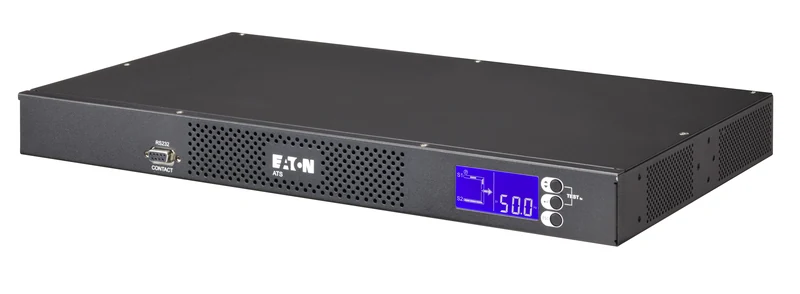
Technical specification
| Model | Current | Poles | Voltage | Transfer time | Type | Mounting | Control / comms |
|---|---|---|---|---|---|---|---|
| EATS16 | 16 A | Single-phase | 208/220/230/240 V | 8 ms typical | Rack | 1U | LCD, local only |
| EATS16N | 16 A | Single-phase | 208/220/230/240 V | 8 ms typical | Rack | 1U | LCD + network (SNMP/web) |
| EATS30 | 30 A | Single-phase | 220/230/240 V | 8 ms typical | Rack | 1U | LED, network |
Source of the values: Eaton ATS datasheet (ATS 16 / ATS 16 Netpack / ATS 30). All three codes are documented in full from Eaton’s own datasheet. EATS30 is rated 30 A up to 35°C, dropping to 25.6 A at 40°C ambient; confirm the site’s ambient temperature before specifying it at full rating. An en dash means the manufacturer does not publish that value in the source we hold; we do not fill it in with an estimate. Confirm every figure against the current manufacturer document before it is written into a contract.
The references we quote in this family are EATS16, EATS16N and EATS30. Send us the load, the phase and the transfer requirement, and we will confirm availability and lead time.
Which one should you choose?
The N suffix is the only difference between EATS16 and EATS16N
Both run at 16 A with identical physical dimensions and outlet configuration; EATS16N simply adds SNMP/web network communication. If remote monitoring is not needed today but might be later, check whether EATS16N costs little enough over EATS16 to future-proof the choice rather than needing a swap.
EATS30’s rating is temperature-dependent, check the room before specifying full load
EATS30 is rated 30 A up to 35 °C ambient, dropping to 25.6 A at 40 °C. A hot aisle or a poorly cooled comms room can genuinely put the ambient above 35 °C, which means the load has to be sized to the derated figure, not the headline 30 A.
This is a genuine cost-saving option versus dual power supplies, not a compromise
Eaton positions this line specifically as more cost-effective than sourcing dual-power-supply equipment across an entire row, since a single ATS covers multiple single-corded devices from one 1U slot. Compare the ATS cost against the price premium of dual-PSU hardware for the actual device count before assuming dual-PSU is always cheaper at scale.
Compare the ATS cost against a second network switch, not just against nothing
The realistic alternative to an ATS is often not “no redundancy” but a second, fully duplicated switch or server with its own power feed. Framed that way, a single 1U ATS covering several single-corded devices is usually the cheaper redundancy path, which is worth stating explicitly in a proposal.
Where it fits, and where it does not
Fits a row of single-corded devices needing a cost-effective 1U redundancy point, with EATS30 for higher-load racks provided the room’s ambient temperature is confirmed. Does not fit a room running consistently above 35 °C ambient without derating the EATS30 load.
What we need in order to quote it
- Load current: 16 A or 30 A
- Whether network monitoring (N suffix) is required
- Room ambient temperature, to confirm EATS30’s derating if applicable
- Outlet count needed (fixed at 8x C13 + 1x C19 across the line)
Request a Quote
Tell us the usable capacity, the protocol and the delivery country. A priced quote comes back within 48 hours, usually with a second option so the trade-off is visible.