Liebert Trinergy Cube: 200 kW to 3.4 MW
Trinergy Cube is the top of Vertiv’s UPS range, spanning 200 kW to 3.4 MW in one architecture. It is a hyperscale product: at these ratings the UPS is not a component you specify but a subsystem the building is designed around. Nothing about it is dropped into an existing room.
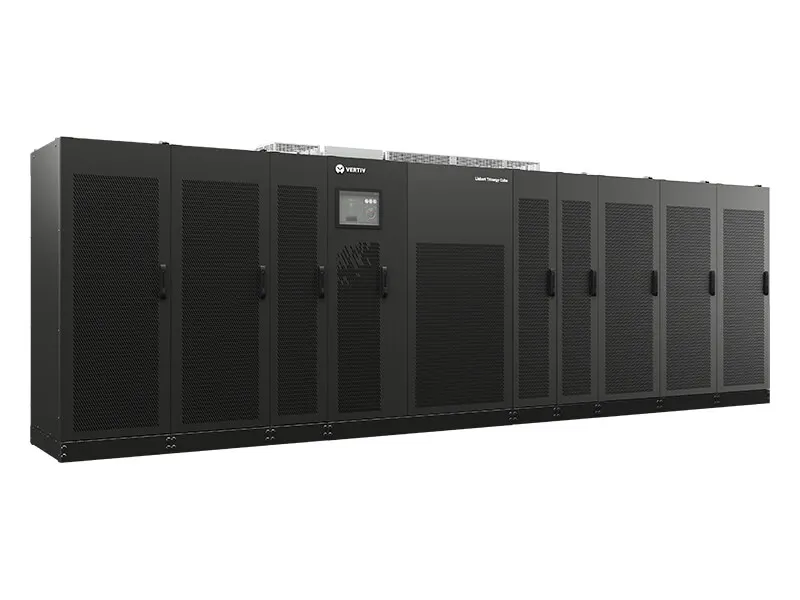
Technical specification
| Model code | Power | Input / output voltage | Phases | Topology | Efficiency | Dimensions W×D×H (mm) | Weight | Parallel / redundancy | Battery type |
|---|---|---|---|---|---|---|---|---|---|
| Trinergy Cube Core 200 kW | 200 kW | Input 280-480 V; output 380/400/415 V, 50/60 Hz | Three-phase + N + PE (or 3PH + PE) | Three-level NPC2 rectifier and inverter; hot-swappable modular cores | Up to 99% in VI mode; up to 99.5% maximum | 500 × 910 × 1950 | 465 kg | Up to 10 cores in one unit, up to 8 units in parallel | VRLA, lithium-ion, pure lead; 396-700 V DC |
| Trinergy Cube Core 400 kW | 400 kW | Input 280-480 V; output 380/400/415 V, 50/60 Hz | Three-phase + N + PE (or 3PH + PE) | Three-level NPC2 rectifier and inverter; hot-swappable modular cores | Up to 99% in VI mode; up to 99.5% maximum | 675 × 910 × 1950 | 610 kg | Up to 10 cores in one unit, up to 8 units in parallel | VRLA, lithium-ion, pure lead; 396-700 V DC |
Source of the values: Vertiv Liebert Trinergy Cube 150 kW to 3.4 MW brochure. The system scales from 150 kW to 3.4 MW in one unit by adding cores; the I/O box is a separate cabinet. An en dash means the manufacturer does not publish that value; we do not fill it in with an estimate. Confirm every figure against the current manufacturer document before it is written into a contract.
The references we quote in this family are Trinergy Cube Core 200 kW and Trinergy Cube Core 400 kW. Send us the reference if you already have one, or the load in kW and the runtime if you do not, and we will confirm availability and lead time.
Which one should you choose?
This is a building project, not a purchase
At megawatt scale the switchgear, the transformer arrangement, the cable routes, the floor loading and the battery room are all sized together with the UPS. Treating it as an equipment order rather than a design workstream is the single most common way these projects slip.
The range spans seventeen times
200 kW and 3.4 MW in one architecture means the same design language covers a large enterprise hall and a hyperscale campus. For an operator running both, that commonality is worth real money in spares, training and monitoring.
Commissioning belongs in the programme
Site acceptance, battery forming and load-bank testing take time and need the room and the generator ready. Put commissioning into the project programme at quotation, not after delivery, because that is where large-power projects usually lose weeks.
Spares and response, not just the unit
At megawatt scale the service agreement is part of the specification. Response time, spare module location and whether an engineer is available in your country change the real availability figure far more than a decimal point of efficiency. Ask what the support looks like in the delivery country before comparing prices.
Load bank and site acceptance
At this scale commissioning does not end on paper: the installation is tested at full load with a load bank, the battery string is formed, and the results are recorded in an acceptance document. Budget the time and the equipment hire for it.
Where it fits, and where it does not
Fits a hyperscale or large campus installation between 200 kW and 3.4 MW where the electrical design is still open. Does not fit an enterprise room under 200 kW and does not fit any project where the switchboard is already built and cannot change.
What we need in order to quote it
- Total load in kW or MW and the redundancy topology
- Single-line diagram or the constraints it must satisfy
- Building and switchgear layout, including cable entry
- Battery technology, runtime and the room allocated to it
- Target commissioning date and the site readiness behind it
Request a Quote
Tell us the load in kW, the runtime you want and the delivery country. A priced quote comes back within 48 hours, usually with a second option so the trade-off is visible.