Huawei UPS5000-S with SmartLi: integrated lithium battery
UPS5000-S is the member of the UPS5000 platform built around SmartLi, Huawei’s integrated lithium battery system, rather than around an external lead-acid string. The battery is not an accessory bolted on afterwards; it is part of the product definition. Footprint saving is the reason sites choose it.
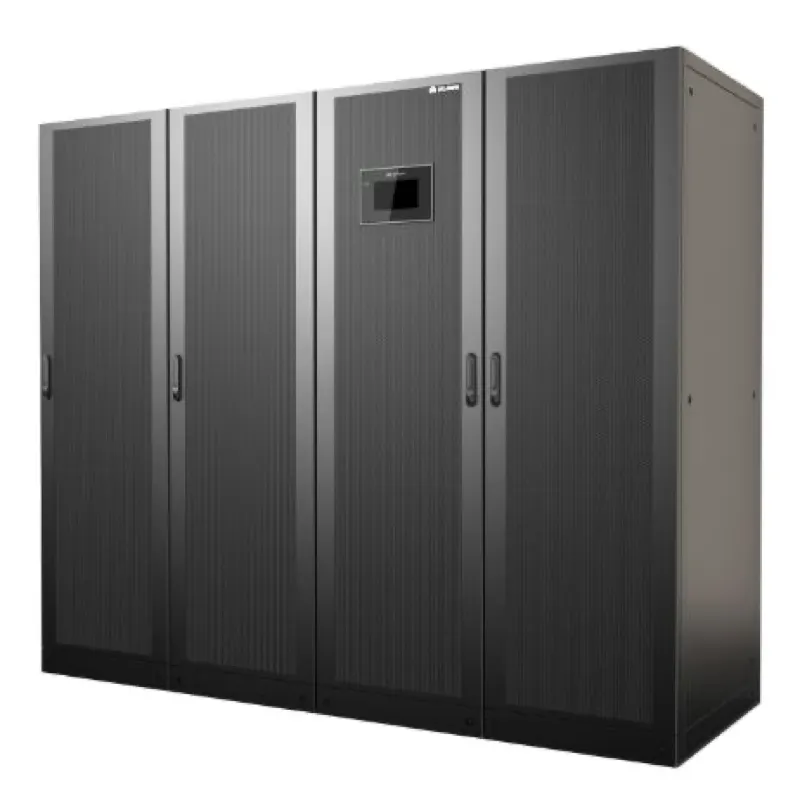
Technical specification
| Model code | Power | Input / output voltage | Phases | Topology | Efficiency | Dimensions W×D×H (mm) | Weight | Parallel / redundancy | Battery type |
|---|---|---|---|---|---|---|---|---|---|
| UPS5000-S serisi | – | – | Three-phase | On-line double conversion, modular, with integrated SmartLi lithium battery | – | – | – | – | Huawei SmartLi lithium-ion |
We hold no manufacturer datasheet for this family yet, so no figure is published here. Send us the load and runtime and we will obtain the current specification from the manufacturer. An en dash means the manufacturer does not publish that value; we do not fill it in with an estimate. Confirm every figure against the current manufacturer document before it is written into a contract.
The references in this family are written as UPS5000-S with the rating appended, and the battery is Huawei SmartLi. We do not hold a current manufacturer datasheet for UPS5000-S, so no figure is published in the table above. Send us the load in kW and the runtime you need and we will obtain the specification and the exact reference from the manufacturer before quoting.
Which one should you choose?
The battery is the product decision
In a conventional installation the UPS is chosen first and the battery arrangement follows. Here the two are specified together, which changes what you compare: not price per kVA but the total area, weight and replacement cycle of the complete power island.
Where lithium repays the premium
Lithium costs more to buy and occupies roughly half the area of an equivalent lead-acid string for the same energy. It repays that where floor space is expensive, where the battery room is already undersized, or where the replacement cycles avoided over the installation life outweigh the initial difference.
It reports its own health
A managed lithium system tells you its state of health instead of leaving you to infer it from annual resistance measurements. On a site that has skipped discharge testing for years, that visibility is often worth more than the energy density.
Check the site rules before the datasheet
Lithium installations are subject to fire, storage and sometimes insurance rules that lead-acid is not. Those rules differ by country and occasionally by building. On an export project, confirm what the destination permits before the specification is fixed, because the answer can rule the product out regardless of its merits.
Insurance and regulatory check
Fire, storage and insurance rules for lithium differ by country and sometimes by building. On an export project, confirm what the destination permits before the specification is frozen; the answer can rule the product out regardless of its technical merits.
Where it fits, and where it does not
Fits a data centre where floor area is the scarce resource, where the battery room is constrained, or where a long installation life makes replacement cycles the dominant cost. Does not fit a project judged purely on lowest purchase price, where lead-acid remains cheaper on day one.
What we need in order to quote it
- Load in kVA or kW and the runtime target
- Floor area and loading limit available for the power island
- Whether lithium is permitted by site or insurer policy
- Expected service life of the installation
- Existing UPS platform, if this extends an estate
Request a Quote
Tell us the load in kW, the runtime you want and the delivery country. A priced quote comes back within 48 hours, usually with a second option so the trade-off is visible.