Dell PowerStore: unified NVMe storage, 500T to 9200T
PowerStore is Dell’s unified storage platform, serving block, file and vVol from one array on NVMe media, with the Gen2 line running from 500T at the entry to 9200T at the top. Unified means one system answers both the SAN and the NAS requirement instead of two. The model number is the performance and capacity class, not a feature difference.
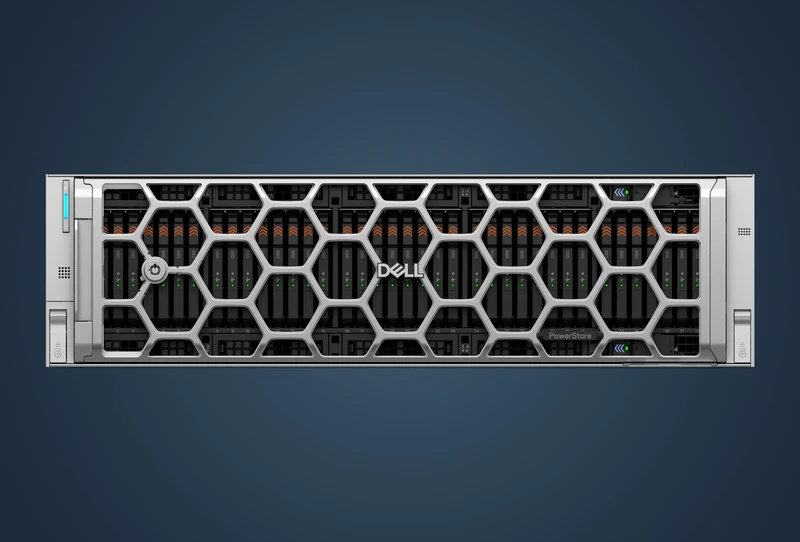
Technical specification
| Model | Type | Maximum capacity | Controller | Protocols | Drive type | Rack U |
|---|---|---|---|---|---|---|
| PowerStore 500T | Unified block, file and vVol; all-NVMe | 1,490 TB raw (6.16 PBe) | Two nodes, 2 Intel Xeon CPUs, 24 cores, 192 GB | FC, iSCSI, NVMe/FC, NVMe/TCP, NFS, SMB | NVMe SSD | 2U |
| PowerStore 1200T | Unified block, file and vVol; all-NVMe | 1,430 TB raw (5.90 PBe) | Two nodes, 4 Intel Xeon CPUs, 40 cores, 384 GB | FC, iSCSI, NVMe/FC, NVMe/TCP, NFS, SMB | NVMe SSD | 2U |
| PowerStore 3200T | Unified block, file and vVol; all-NVMe | 1,430 TB raw (5.90 PBe) | Two nodes, 4 Intel Xeon CPUs, 64 cores, 768 GB | FC, iSCSI, NVMe/FC, NVMe/TCP, NFS, SMB | NVMe SSD | 2U |
| PowerStore 3200Q | Unified block, file and vVol; all-NVMe | 1,430 TB raw (5.90 PBe) | Two nodes, 4 Intel Xeon CPUs, 64 cores, 768 GB | FC, iSCSI, NVMe/FC, NVMe/TCP, NFS, SMB | QLC NVMe SSD | 2U |
| PowerStore 5200T | Unified block, file and vVol; all-NVMe | 1,430 TB raw (5.90 PBe) | Two nodes, 4 Intel Xeon CPUs, 96 cores, 1,152 GB | FC, iSCSI, NVMe/FC, NVMe/TCP, NFS, SMB | NVMe SSD | 2U |
| PowerStore 9200T | Unified block, file and vVol; all-NVMe | 1,430 TB raw (5.90 PBe) | Two nodes, 4 Intel Xeon CPUs, 112 cores, 2,560 GB | FC, iSCSI, NVMe/FC, NVMe/TCP, NFS, SMB | NVMe SSD | 2U |
Source of the values: Dell PowerStore Gen2 specification sheet. Capacity is per appliance; up to four appliances form a cluster. An en dash means the manufacturer does not publish that value; we do not fill it in with an estimate. Confirm every figure against the current manufacturer document before it is written into a contract.
The references we quote in this family are PowerStore 500T, PowerStore 1200T, PowerStore 3200T, PowerStore 3200Q, PowerStore 5200T and PowerStore 9200T. Send us the reference if you already have one, or the usable capacity and the protocol you need if you do not, and we will confirm availability and lead time.
Scaling up and scaling out are different purchases
A PowerStore appliance scales up by adding drives and scales out by joining a cluster of up to four appliances, and the two paths cost different money for the same terabyte. Scaling up is cheaper per terabyte and keeps one management point, but it stops at the appliance ceiling of roughly 1.43 PB raw. Scaling out raises the ceiling to more than 23 PBe per cluster and adds controller capacity with it, which is what you want when the constraint is processing rather than space. A cluster can mix appliance models, so a 500T bought this year and a 5200T bought in three years can serve the same namespace. Decide which curve you are on before the first order, because a single large appliance and a cluster of small ones reach the same capacity at very different prices and with very different failure domains.
Which one should you choose?
Unified is a consolidation decision
If you currently run a SAN for your virtualisation cluster and a separate NAS for file shares, a unified array replaces two systems, two support contracts and two sets of operational knowledge with one. The saving is mostly operational rather than in list price, so it is worth most where the storage team is small.
Where to enter the range
The 500T is the entry class and suits a single site or a departmental workload. The 3200T and 5200T are the mainstream, and the 9200T is for consolidated estates. Enter on the performance you need at the end of the refresh cycle, not at the start, because moving up a class later means a migration.
The Q suffix is not a T
The 3200Q is a different media configuration from the 3200T and therefore a different price and performance point. Choosing between them follows from whether your workload is latency-sensitive or capacity-driven. Read the two as separate options, not as a discount version of each other.
Raw is not usable
Every array quotes raw capacity and delivers usable capacity, and the gap depends on protection level and data reduction. Data reduction results depend on your data, not on the datasheet. We quote both figures separately so the comparison against another vendor is like for like.
What we need to quote
Usable capacity required, the protocols your hosts speak, the performance target in IOPS or latency, and the growth expected over the contract period. If this replaces an existing array, its current utilisation is the most useful number you can send us.
Request a Quote
Send the usable capacity, the protocol your hosts speak and the performance target. A priced quote comes back within 48 hours with the raw and usable figures separated.