HPE MSA Gen6: 2U hybrid entry SAN
MSA 2060 and MSA 2062 are HPE’s entry SAN arrays: a 2U chassis, dual hot-swappable active/active controllers, 24 GB of cache and eight host ports. The published ceiling is 7.37 PB and up to 395,000 IOPS. The design goal is an array a general IT team can run without a storage specialist.
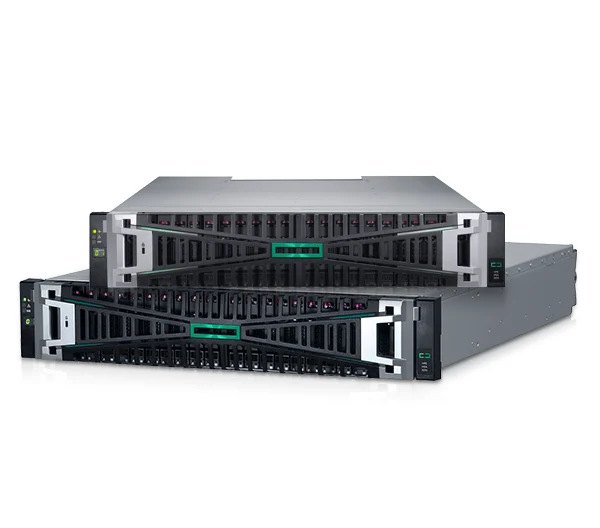
Technical specification
| Model | Type | Maximum capacity | Controller | Protocols | Drive type | Rack U |
|---|---|---|---|---|---|---|
| MSA 2060 | Flash-ready hybrid entry SAN | Up to 7.37 PB; up to 395,000 IOPS | Dual hot-swappable active/active controllers, 24 GB cache, 8 host ports | 16Gb FC, 10GbE iSCSI, 10GBase-T, 12Gb SAS | SSD, SAS and midline SAS (LFF or SFF) | 2U |
| MSA 2062 | Flash-ready hybrid entry SAN | Up to 7.37 PB; up to 395,000 IOPS | Dual hot-swappable active/active controllers, 24 GB cache, 8 host ports | 16Gb FC, 10GbE iSCSI, 10GBase-T, 12Gb SAS | SSD, SAS and midline SAS (LFF or SFF) | 2U |
Source of the values: HPE MSA 2060 QuickSpecs and data sheet. 2U chassis takes 12 LFF or 24 SFF drive bays depending on model. An en dash means the manufacturer does not publish that value; we do not fill it in with an estimate. Confirm every figure against the current manufacturer document before it is written into a contract.
The references we quote in this family are MSA 2060 and MSA 2062. Send us the reference if you already have one, or the usable capacity and the protocol you need if you do not, and we will confirm availability and lead time.
Which one should you choose?
LFF or SFF is a capacity-versus-spindle choice
The same 2U chassis takes either twelve 3.5-inch bays or twenty-four 2.5-inch bays. Large-form-factor gives cheaper terabytes; small-form-factor gives more drives and therefore more parallel I/O in the same rack space. Pick on the workload profile, because the chassis is not convertible after purchase.
2060 and 2062 differ in what ships inside
Both are the same platform. The distinction is the bundled flash configuration rather than a different controller or a different ceiling. If a quote compares them purely on price, ask what drives are in each, because that is where the difference sits.
Protocol is fixed in the controller
MSA 2060 controllers come as 16Gb Fibre Channel, 10GbE iSCSI, 10GBase-T or 12Gb SAS. There are no converged controllers in this generation, so the array speaks one host protocol and changing it later means changing controllers. Confirm what the hosts use before the order, not after.
Tiering does the work an administrator would
The automated tiering engine moves hot data onto the fastest media as the workload changes, which is the feature that makes a hybrid array behave acceptably without daily tuning. It works best when there is a real flash tier to move data into; an all-disk configuration has nowhere to promote to.
Know the ceiling before you plan growth
7.37 PB is the family maximum with expansion enclosures, not what a base array holds. For a small site the practical limit is usually the number of expansion shelves the budget and the rack allow. Tell us the three-year capacity target and we will say whether MSA reaches it or whether the conversation should start one class higher.
Where it fits, and where it does not
Fits a small or remote office, a branch site or a departmental workload that needs shared block storage with dual-controller redundancy at an entry price. Does not fit a site needing file services from the same array, and does not fit a workload whose growth curve passes the family ceiling inside the depreciation period.
What we need in order to quote it
- Usable capacity today and the three-year target
- Host protocol in use: FC, iSCSI, 10GBase-T or SAS
- LFF or SFF, and how much of it must be flash
- Rack units available and whether expansion shelves fit
- Whether a second array is needed for replication
Request a Quote
Tell us the usable capacity, the protocol and the delivery country. A priced quote comes back within 48 hours, usually with a second option so the trade-off is visible.