Dell PowerEdge R series (AMD): EPYC-based rack servers
The AMD side of the PowerEdge R line runs 4th generation EPYC 9004 processors across four codes: R6615 and R7615 are single-socket 1U/2U, R6625 and R7625 are dual-socket with up to 96 or 128 cores per processor. This line exists for workloads where core count and PCIe lane count per dollar matter more than per-core clock speed.
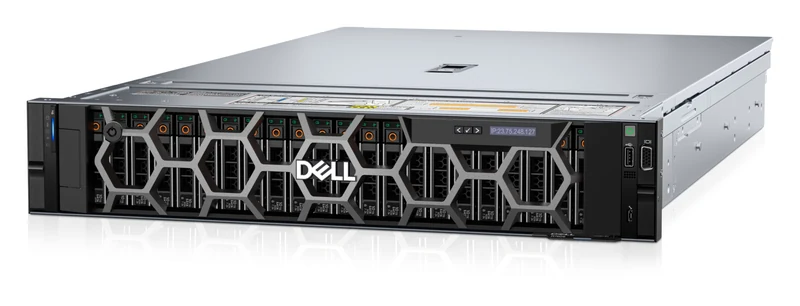
Technical specification
| Model | Form factor | Socket / processor generation | Max memory | Drive bays | GPU support | Power supply | Network |
|---|---|---|---|---|---|---|---|
| R6615 | 1U | 1x AMD EPYC 9004, single-socket | – | Up to 16x 2.5″ / 16x EDSFF E3.S | – | – | – |
| R6625 | 1U | 2x AMD EPYC 9004, up to 96 cores each | 24x DDR5, 3 TB max | – | Up to 2x 75 W single-wide | – | – |
| R7615 | 2U | 1x AMD EPYC 9004, single-socket | – | – | – | – | – |
| R7625 | 2U | 2x AMD EPYC 9004, up to 128 cores each | 24x DDR5 | Up to 24x 2.5″ / 12x 3.5″ / 32x E3.S Gen5 | Up to 2x 300 W double-wide or 6x 75 W single-wide | Up to 3200 W Titanium, hot-swap redundant | – |
Source of the values: Dell PowerEdge R6615/R6625/R7615/R7625 spec sheets (delltechnologies.com). Sourced from Dell’s public spec sheets for this line (delltechnologies.com); we do not hold the PDF copies locally, so cells not stated in the pages we checked stay blank rather than being carried over from a sibling model. An en dash means the manufacturer does not publish that value in the source we hold; we do not fill it in with an estimate. Confirm every figure against the current manufacturer document before it is written into a contract.
The codes we quote in this family are R6615, R6625, R7615 and R7625. Send us the workload and the constraints, and we will confirm availability, lead time and the exact configuration.
Which one should you choose?
Single-socket is not a downgrade, it is a different economics
R6615 and R7615 run one EPYC 9004 processor but still expose a large PCIe lane count and drive count, because a single modern EPYC often outperforms two smaller processors in per-socket licensing costs (databases, some hypervisors). Compare total cost of ownership, not just core count, before dismissing the single-socket option.
R7625’s drive flexibility is unusually wide
R7625 takes 24x 2.5-inch, 12x 3.5-inch or 32x EDSFF E3.S Gen5 drives from the same base chassis, which lets one hardware SKU serve both a capacity-storage role and a high-IOPS NVMe role depending only on the drive configuration ordered. Decide the storage profile before ordering rather than after.
GPU support exists but is modest compared to the dedicated AI line
R6625 takes up to two 75 W single-wide GPUs and R7625 up to two 300 W double-wide or six 75 W single-wide cards; enough for inferencing or light acceleration, not for training large models. For serious GPU density, the PowerEdge GPU/AI family (XE9680/XE9640/XE8640) is the right page to quote from.
Power supply headroom scales with the socket count
The dual-socket R7625 offers PSU options up to 3200 W Titanium, well above what the single-socket R6615/R7615 need. Match the PSU tier to the actual configuration rather than defaulting to the largest option, since an oversized PSU runs less efficiently at typical server load.
Where it fits, and where it does not
Fits a workload where AMD’s core-count and PCIe-lane economics beat Intel’s per-core pricing; dense virtualization, software-defined storage, or database consolidation. Does not fit a site standardised on Intel for driver or support reasons, where the R series (Intel) page is the match.
What we need in order to quote it
- Single or dual socket requirement
- Drive protocol and count needed from the R7625’s flexible bays
- Whether any GPU acceleration is needed and at what tier
- Power circuit available at the rack
Request a Quote
Tell us the usable capacity, the protocol and the delivery country. A priced quote comes back within 48 hours, usually with a second option so the trade-off is visible.